How to Report Nursing Home Abuse in Florida

That first gut-wrenching moment when you suspect your loved one is being abused or neglected is a mix of anger, disbelief, and fear. Your mind races. What do I do? Who do I call?

To report nursing home abuse in Florida, your first two calls should be to the state's Long-Term Care Ombudsman Program at 1-888-831-0404 and the Florida Abuse Hotline for Adult Protective Services (APS) at 1-800-96-ABUSE. Making these calls kicks off the official investigation process, but before you pick up the phone, your absolute first priority is making sure your family member is safe.

Your First Actions When Suspecting Abuse

How to Report Nursing Home Abuse in Florida

It’s incredibly distressing to find signs of mistreatment. It’s okay to feel overwhelmed, but what you do in these first few hours is critical. We'll walk through a clear, calm plan to get your loved one out of harm's way and start the reporting process correctly.

This problem is far more widespread than most people imagine. The sad truth is that most incidents are never even brought to light. Some of the statistics are just staggering—experts estimate that only 1 in 24 cases of elder abuse ever gets reported.

Think about that. The vast majority of victims are left to suffer in silence. In one major study of over 2,000 nursing home residents, 44% said they had been abused, and an unbelievable 95% reported that they had either been neglected themselves or had seen another resident being neglected. You can learn more about these nursing home abuse statistics to see just how deep this crisis runs.

Assess the Immediate Danger

First things first: is your loved one in immediate danger? Trust your instincts. If you see signs of a serious physical injury, if they are being threatened, or if they're in acute medical distress from neglect, don't hesitate. Call 911 immediately. This is the only right answer in an emergency.

If the situation isn't a life-threatening emergency—maybe you've noticed unexplained bruises, a sudden decline in hygiene, or troubling changes in their personality—the goal is to create a safe space to talk. Try to speak with them privately, away from any staff members who might overhear or intimidate them.

Begin Your Documentation Log

Before making a single phone call, grab a notebook or open a new note on your phone. This is going to become your evidence log. It's so easy to forget small but crucial details when you're under stress.

Write down the date and time of your visit and everything you observed. Be specific.

  • What did you see? Instead of "a bruise," write "A dark purple bruise, the size of a quarter, on Mom's left forearm."
  • What did you hear? Document direct quotes if you can. For example, "Dad said 'the big aide with the tattoo' is always rough when moving him from the bed to his chair."
  • Who was present? Note which staff members were on duty, even if they weren't directly involved. "Nurse Jane Doe was at the nursing station when I arrived."

This log will be the foundation of your official report. A detailed, written timeline is infinitely more powerful than a panicked, vague recollection.

Taking a few moments to write down exactly what you observed—using objective language—provides clarity and credibility. This simple act transforms a general concern into actionable evidence that agencies can use to start a meaningful investigation.

Making the Initial Report

With your initial notes ready, it’s time to take action. It can be confusing trying to figure out who to call first, but Florida has a very clear system. You don’t have to pick just one agency; in fact, you should often contact several. The idea is to build a team of advocates and investigators who can tackle the problem from multiple angles.

To help you get started, here’s a quick-reference guide to the main contacts in Florida.

Florida Nursing Home Abuse Reporting Quick-Reference Guide

This table breaks down who to call, why, and when. Each agency plays a different but essential part in protecting residents and making sure facilities are held responsible.

Agency/Hotline Contact Information Primary Role
Emergency Services 911 Call for any immediate medical emergencies or if a crime is in progress.
Long-Term Care Ombudsman 1-888-831-0404 A resident advocate who investigates and helps resolve complaints confidentially.
Adult Protective Services (APS) 1-800-96-ABUSE (1-800-962-2873) The state's primary agency for officially investigating abuse, neglect, and exploitation.
Agency for Health Care Admin (AHCA) 1-888-419-3456 The state agency that licenses and regulates nursing homes; investigates facility-wide safety and compliance.

For most situations, you'll want to start by calling both the Ombudsman and APS. They operate on parallel tracks—one focused on advocating for your loved one, the other on investigating the report of abuse. Getting them involved sends an immediate and powerful message to the nursing home that their actions are being watched.

Recognizing the Signs of Elder Abuse and Neglect

How to Report Nursing Home Abuse in Florida

Abuse in a nursing home rarely looks like it does on TV. It's usually not a single, dramatic event. Instead, it’s often a slow burn—a series of small, unsettling incidents that are easy to brush off on their own. The first step in learning how to report abuse is learning to trust your gut when those small things start adding up to a pattern that just feels wrong.

The key is to pay close attention to any changes in your loved one’s physical health, emotional state, or overall dignity. What might seem minor at first can often be a sign of a much larger problem.

Uncovering Physical Warning Signs

When people think of physical abuse, they usually picture bruises. But it’s much more than that. While any injury that can't be explained is a huge red flag, the type and location of an injury can tell you a lot. For example, bruises on the inner arms or thighs are highly suspicious, as those aren't areas someone typically bumps during an accidental fall.

You need to look for patterns that point to force or restraint:

  • Fingerprint-shaped marks on the arms, wrists, or neck are a tell-tale sign of someone being grabbed or held down.
  • Matching bruises on both sides of the body, like on both upper arms, might suggest someone was squeezed or restrained.
  • A history of repetitive injuries, like frequent sprains or fractures, could indicate ongoing mistreatment, not just a series of unlucky accidents.

And don't forget to watch their body language. A resident who suddenly becomes afraid of being touched or who visibly flinches when a caregiver gets close is telling you something is wrong, even if they can't find the words.

Recognizing the Signals of Neglect

Neglect is a quieter, more insidious form of harm, but it can be just as deadly. It’s not about an action, but a lack of action—a facility’s failure to provide the basic standard of care your loved one needs to stay healthy and safe.

The signs often pile up over time. You might notice their personal hygiene slipping, with unkempt hair, dirty fingernails, or a persistent body odor. Their room might be consistently dirty, with soiled sheets or an overflowing trash can.

One of the most alarming red flags for neglect is sudden, unexplained weight loss. This can mean they aren't getting enough food, aren't receiving help with eating, or a serious health issue is being completely ignored by the staff.

Another critical sign is the appearance of pressure ulcers, better known as bedsores. These painful wounds are almost always preventable with basic care, like turning a resident regularly and keeping their skin clean. Finding a bedsore is a powerful signal of serious neglect. Because these are such a clear indicator, we've put together a resource on how to handle bedsore claims in our detailed guide.

Spotting Emotional and Psychological Abuse

Emotional abuse is invisible, but the damage it does is very real. It can be anything from verbal insults and threats to intimidation and deliberate isolation. The abuser’s goal is to control, humiliate, and scare the resident. The evidence is almost always behavioral.

Keep an eye out for any sudden, drastic shifts in your loved one's personality:

  • Uncharacteristic withdrawal: A person who was once outgoing suddenly becomes silent, non-communicative, or refuses to participate in activities.
  • Sudden agitation or fear: They might seem constantly on edge, especially around a particular staff member.
  • Repetitive, self-soothing behaviors: Things like rocking back and forth or mumbling can be a response to severe stress or trauma.

If your loved one seems afraid to speak openly when staff members are around, that's a major red flag. They may have been threatened or told they'll be in trouble if they complain to family.

Identifying Financial Exploitation

Financial abuse is a calculated crime that targets a resident’s trust and vulnerabilities. It can start small, making it incredibly hard to spot until the financial damage is already significant.

The warning signs usually show up in their bank statements and personal environment:

  • Unexplained withdrawals or strange charges on their accounts.
  • Personal items going missing, like jewelry, cash, or new electronics you brought them.
  • Sudden changes to a will, trust, or power of attorney, especially if a new staff member is suddenly listed as a beneficiary.
  • Bills going unpaid or collection notices arriving, even though they should have plenty of money to cover their expenses.

Be immediately suspicious if a caregiver takes an unusual interest in your loved one's finances or tries to isolate them from you during financial discussions. This is a classic tactic abusers use to gain control and access their money.

How to Effectively Document What You Witness

When you suspect something is wrong, what you see and hear is more than just a gut feeling—it's potential evidence. Building a strong case against nursing home abuse or neglect hinges on your ability to document everything clearly and consistently. This isn't about starting a fight; it's about creating an undeniable, objective record that can protect your loved one.

Think of yourself as a quiet observer, gathering facts. Your notes and photos will transform a general sense of unease into a specific, actionable complaint that investigators, state agencies, and attorneys can use.

Start a Dedicated Journal—Today

The single most important thing you can do right now is start a journal. It can be a simple notebook or a digital file, but keep it dedicated solely to this purpose. From this point forward, every entry needs to start with the date and time of your visit or conversation.

Vague notes won't cut it. "Mom seemed sad" is easy to dismiss. Detailed observations are not.

  • Capture Direct Quotes: Don't paraphrase. Write down exactly what was said. For example, "At 2:15 PM, I asked why Dad’s bedsheets were soiled. Nurse Smith told me, 'We're short-staffed again.'"
  • Note Who Was There: Get the names and titles of the nurses, aides (CNAs), and any administrators you speak with. Who was on duty? Who witnessed the event?
  • Describe the Scene: Instead of "the room was messy," get specific. "Entered Room 204 at 10:00 AM. Observed an overflowing trash can, dried food on the bedside table, and a strong smell of urine."

This journal does more than just record incidents; it creates a timeline. That timeline can reveal patterns of neglect or repeated abuse that are impossible for the facility to ignore.

Take Clear, Compelling Photos

A picture is worth a thousand words, especially when it shows something that shouldn't be there. Photos and videos can be incredibly powerful, but you have to capture them the right way. Your phone automatically date- and time-stamps images, which is perfect for this.

Focus your camera on capturing undeniable proof of:

  • Visible Injuries: Get clear shots of bruises, cuts, bedsores, and any other unexplained marks. Take pictures from different angles and in good light so the injury is clearly visible.
  • Unsanitary Living Conditions: Snap photos of dirty rooms, soiled bedding, pest problems, or dangerous clutter in hallways that could cause a fall.
  • Obvious Signs of Neglect: If your loved one looks unkempt, is wearing dirty clothes, or shows clear signs of poor hygiene, document it with a photo.

A Pro Tip From Experience: When you photograph an injury, place a common object like a quarter next to it. This simple trick provides an immediate sense of scale, helping investigators grasp the true size and severity of the wound.

Gather and Organize Key Paperwork

Your own observations are just one piece of the puzzle. The facility's own paperwork can often tell the real story of what’s happening when you aren't around.

You have a right to your loved one's medical records. Request a copy and go through them carefully. Look for reports of unexplained injuries, sudden changes in medication that weren't discussed with you, or any inconsistencies in the nursing notes.

Keep a sharp eye on their financial statements, too. Financial exploitation is a quiet but devastating form of abuse. Watch for unusual bank withdrawals, strange credit card charges, or sudden changes to a will or power of attorney. Start a file and keep everything organized—bank statements, facility bills, and medical reports. This level of detailed proof is absolutely vital, especially if you decide to explore your legal options. You can see how this evidence plays a crucial role by learning more about nursing home claims and how they are built.

Identify Potential Witnesses

Chances are, you're not the only person who has noticed that something is wrong. Other residents, their family members, and even a few compassionate staff members could be potential witnesses. You're not a private investigator, but you can discreetly note who might have seen or heard something important.

In your journal, jot down the names of other visitors who were in the room during an incident or a staff member who looked genuinely concerned. If another resident tells you about their own mistreatment, note their name and what they told you. This is invaluable information you can pass along to official investigators, who are trained to conduct proper interviews. Having someone else to back up your story can make all the difference, confirming the problem is real and not just an isolated event.

Who Do You Call? Navigating Florida's Reporting Agencies

When you suspect abuse, figuring out who to call can feel overwhelming, especially when you're already in a stressful situation. Florida has several agencies designed to help, but each plays a distinct role. It’s not about finding one "perfect" number; it's about alerting the right professionals who can tackle the problem from different angles.

Knowing the difference between these groups is crucial. Contacting the right one first ensures your complaint is handled by investigators with the proper authority and gets the fastest, most effective response. An ombudsman, for example, is an advocate for resident rights, while Adult Protective Services (APS) conducts formal abuse investigations. Let's break down who does what.

The Long-Term Care Ombudsman Program: Your Resident Advocate

Think of the Ombudsman Program as your loved one's personal advocate, a neutral problem-solver who works for the resident, not the facility. These trained representatives are your best first call for issues that impact quality of life, dignity, and resident rights.

They are the people to call when you have concerns about:

  • Poor hygiene, unanswered call lights, or consistently cold food.
  • Disputes over the resident's care plan.
  • Problems with how a resident's personal funds are being handled.
  • Any situation where you feel the resident isn’t being heard or respected by staff.

An ombudsman’s goal is to resolve problems through mediation and negotiation. Their services are free and completely confidential. While they don't launch a formal state investigation, they have the authority to access records and work within the system to fix things. For many families, they are an invaluable first line of defense.

Adult Protective Services (APS): The Official Investigators

When a situation moves beyond a quality-of-care issue and into potential abuse, neglect, or exploitation, your immediate call must be to Florida's Adult Protective Services (APS).

APS is the agency tasked with officially investigating serious allegations. You can reach them 24/7 through the Florida Abuse Hotline at 1-800-96-ABUSE.

Once you make a report, an investigator is assigned to assess the resident's immediate safety and conduct a full investigation. This involves interviewing the resident, family, and staff, as well as reviewing medical charts and other records. Their sole focus is to determine if abuse occurred and to put protective services in place. Their findings are critical and can be used as evidence if you decide to take legal action later.

An ombudsman resolves disputes, but APS investigates potential crimes and serious violations. If you believe your loved one has been physically harmed, financially exploited, or dangerously neglected, calling APS isn't optional—it's essential.

The Agency for Health Care Administration (AHCA): The Facility Regulator

The Agency for Health Care Administration (AHCA) is the state entity that licenses and regulates every nursing home in Florida. Think of them as the "facility police." While APS focuses on the victim, AHCA focuses on whether the facility is following state and federal laws.

File a complaint with AHCA when you see systemic problems that endanger all residents, such as:

  • Inadequate staffing levels that lead to widespread neglect.
  • Unsafe building conditions or unsanitary living areas.
  • Repeated failures in infection control.
  • Clear violations of state regulations you've observed during visits.

An AHCA investigation can lead to serious consequences for the facility, including fines, sanctions, or even having its license revoked. Reporting to AHCA holds the entire organization accountable.

Local Law Enforcement: For Criminal Acts

It’s critical to remember that some actions are more than just rule violations—they are crimes. Physical abuse, sexual assault, and theft are criminal acts and must be reported to the police.

If you witness a crime or have strong evidence one has occurred, call your local police department or sheriff's office immediately. Use 911 for emergencies in progress. Otherwise, use the non-emergency line to file a police report. A police investigation is completely separate from the administrative ones run by APS or AHCA and is the only way to hold an abuser personally accountable under criminal law.


Comparing Florida's Key Reporting Agencies

Trying to decide who to contact first can be confusing. This table gives you an at-a-glance comparison of the primary agencies, their focus, and what you can expect from each.

Agency Primary Focus Typical Outcome Best For
Long-Term Care Ombudsman Resident rights, quality of care, dispute resolution Mediation, problem-solving, policy changes Resolving day-to-day care issues and ensuring resident dignity.
Adult Protective Services (APS) Investigating abuse, neglect, and exploitation Safety plans, protective services, official findings of abuse/neglect Suspected physical, emotional, sexual, or financial harm.
Agency for Health Care Admin. (AHCA) Facility compliance with state/federal laws Fines, sanctions against the facility, license revocation System-wide problems like understaffing or unsafe conditions.
Local Law Enforcement Criminal acts (assault, theft, etc.) Arrest, criminal charges, and prosecution of the individual perpetrator When you believe a specific crime has been committed against your loved one.

Remember, you don't have to pick just one. In many cases, especially serious ones, you may end up reporting the situation to APS, AHCA, and the police.

When you're first getting your thoughts in order, a simple flowchart can help you focus on the most important first steps.
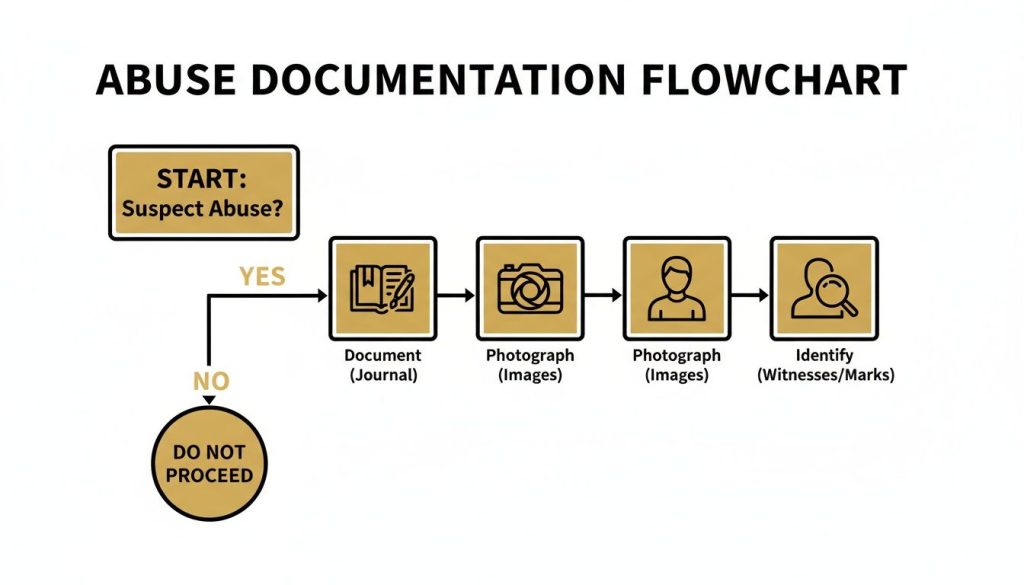
How to Report Nursing Home Abuse in Florida

As you can see, your first actions should always center on creating a factual record. Document what happened, take photos if possible, and identify the key people involved. This groundwork is vital no matter which agency you contact.

When It's Time to Call a Nursing Home Abuse Attorney

State agencies do a vital job investigating facilities and enforcing regulations, but their focus is on the facility's compliance, not your family's personal losses. Their goal is to get the home back in line with state rules. A nursing home abuse attorney, however, works for you and only you. Their mission is to fight for justice and get financial recovery for the harm your loved one suffered.

So, when do you make that call? It’s a crucial decision point. If the abuse or neglect led to a serious physical injury, deep emotional trauma, or a major financial hit, it's time to speak with an attorney. They can look at the facts and give you a straight answer about whether you have a strong case and what your family's legal rights are.

You Have a Right to Compensation

A civil lawsuit is completely separate from any fines or penalties the state might levy against the nursing home. This is about holding the facility financially responsible for the specific damages their negligence or abuse caused your family. An experienced lawyer can help you fight for compensation that covers a lot more than just the immediate medical bills.

Here’s a look at what we typically pursue in a nursing home abuse case:

  • Medical Expenses: This covers everything from the initial hospital stay and doctor's appointments to ongoing physical therapy and any future medical care needed because of the injuries.
  • Pain and Suffering: This is compensation for the actual physical pain and emotional anguish the resident was forced to endure. It's an acknowledgment of the human cost of their neglect.
  • Disability or Disfigurement: If the injury is permanent and affects your loved one’s quality of life or changes their appearance, this is meant to compensate for that loss.
  • Wrongful Death: Tragically, abuse and neglect can be fatal. If this happens, the family has the right to file a wrongful death claim to hold the facility accountable.

The ultimate goal is to secure funds that can pay for better care in a new facility, cover all the unexpected costs, and deliver a measure of justice for the inexcusable harm that was done.

Let's be clear: no amount of money can ever erase the trauma of abuse. But a successful civil claim does something else—it sends a powerful message that failing to protect residents will have severe financial consequences. Often, that financial pressure is the single biggest motivator for a facility to finally make real, lasting changes to how they operate.

Finding the Right Legal Partner for This Fight

These are not simple personal injury cases. Florida's nursing home regulations are a maze, and you absolutely need a legal team that lives and breathes this specific area of law. Don't just go with any firm; look for one with a proven track record of going up against these large long-term care corporations and winning.

When you're meeting with potential attorneys, ask them directly about their experience with cases just like yours. Ask how familiar they are with AHCA and Adult Protective Services. You want a lawyer who knows exactly how to take the findings from a state investigation and use them to build an even stronger civil case. The right legal team truly makes all the difference, which is why it’s so important to find the right nursing home abuse attorneys who will best represent your family.

How to Prepare for Your First Consultation

Any reputable nursing home abuse lawyer will offer a free, no-obligation consultation. This is your chance to tell your story and for them to give you an honest assessment of your case. To get the most out of this meeting, you need to walk in prepared.

That documentation log you’ve been keeping? It's your most powerful tool now.

Bring it with you, organized and ready to go. Here’s what you should have:

  • Your Detailed Journal: The timeline of what happened, your observations, and notes from every conversation.
  • Photos and Videos: Any visual proof you have of injuries, dirty rooms, or anything else that shows neglect.
  • Key Paperwork: Copies of medical records you've managed to get, financial statements showing strange withdrawals, and any letters or emails you've exchanged with the facility's management.
  • A List of Witnesses: Names and contact info for any staff members, other residents, or visitors who saw something and might be willing to speak up.

When you lay all this out, you’re not just having a conversation; you're starting a strategic planning session. It gives the attorney the ammunition they need to provide a clear, informed analysis of your legal options and sets a strong foundation for the fight ahead.

Answering Your Most Pressing Questions About Reporting Abuse

Making the call to report suspected abuse is tough. It’s natural to feel a mix of anger, fear, and uncertainty. You're worried about your loved one, and the whole process can seem overwhelming. Let's walk through some of the most common concerns we hear from families just like yours.

What If the Nursing Home Retaliates Against My Loved One?

This is, without a doubt, the number one fear families have. Let me be clear: It is 100% illegal for a nursing home to retaliate against a resident or their family for reporting abuse. That said, the fear itself is very real and needs to be handled head-on.

When you make your report to the Long-Term Care Ombudsman or Adult Protective Services, tell them you are worried about retaliation. They are trained for this. Investigators can conduct unannounced visits and increase their monitoring to ensure nothing happens. Another powerful move is to have an attorney send a formal letter to the facility. This puts them on notice that their actions are being watched closely under the threat of legal action.

Can I Make an Anonymous Report in Florida?

Yes, you absolutely can. The Florida Abuse Hotline allows you to report your concerns to Adult Protective Services without giving your name. It’s a crucial option for those who fear for their own safety or job.

However, from an investigator's perspective, a report is often stronger when they have a contact person. It lets them ask follow-up questions that could be the key to cracking the case. By law, your identity is kept confidential from the nursing home, so you can provide your name without them ever knowing you were the one who made the report. The Ombudsman program is also bound by strict confidentiality, always putting the resident's wishes first.

The ultimate goal is to protect the resident. While you can report anonymously, confidentially providing your contact info often gives investigators the tools they need to build a much stronger case.

How Long Will the Investigation Take?

This really depends on who is investigating and how complicated the situation is. There isn't a single timeline, as each agency has its own process.

  • Adult Protective Services (APS): If your report suggests immediate danger, APS has to start its investigation within 24 hours. A complete investigation usually wraps up in 30 to 60 days.
  • Agency for Health Care Administration (AHCA): When AHCA investigates a facility for breaking state rules, it can be a longer haul. These reviews often take several weeks or even months.
  • A Civil Lawsuit: If you hire an attorney to file a lawsuit, that’s a completely separate track. These cases follow their own legal schedule and can take many months or even over a year to resolve.

What Happens When a Nursing Home Is Found Guilty?

When an investigation proves that abuse or neglect occurred, the consequences can be serious. If a state agency like AHCA confirms the findings, the nursing home could be hit with massive fines, be barred from admitting new residents, or, in the worst cases, lose its license entirely.

If law enforcement gets involved and criminal charges are filed, individual staff members could face prosecution and jail time. And if a civil lawsuit is successful, the facility is ordered to pay financial compensation to the victim and their family. This money is meant to cover medical costs, account for pain and suffering, and hold the facility financially responsible for the immense harm they caused.


When your family is facing the devastating reality of nursing home abuse, you need advocates who will fight tirelessly on your behalf. Tarrash & Tarrash has the experience and determination to hold negligent facilities accountable and secure the justice your loved one deserves. If you suspect abuse, contact us for a free, confidential consultation to understand your legal options at https://tarrashlaw.com

Accident Victim Legal Options: A Practical Guide for Florida Residents

Accident victim legal options range from filing an insurance claim and pursuing a personal injury lawsuit to seeking alternative dispute resolution like mediation — and choosing the right path can make a major difference in recovery. For someone healing from injuries, handling property damage, or protecting an elderly family member’s rights, knowing the legal routes available and what each involves is the first step toward securing fair compensation and peace of mind.

Why understanding your options matters

An accident throws people into unfamiliar territory: medical bills pile up, time off work drains income, and dealing with insurers can be overwhelming. Each legal option has different timelines, evidence requirements, and potential outcomes. Early decisions — like whether to accept an insurer’s settlement offer, file a claim against a negligent party, or involve an attorney — shape the final result. That’s why accident victims who understand their legal options tend to recover more and stress less.

Immediate steps after an accident

Before diving into the legal pathways available, it helps to start with practical, evidence-preserving steps. These actions improve the odds of a successful claim no matter which legal option the victim ultimately chooses.

  • Get medical attention. Treat injuries right away. The medical record is often the most important evidence in a personal injury case.
  • Report the incident. For car accidents, call law enforcement and make a police report. For slip-and-fall at a store, notify management and ask for an incident report.
  • Document everything. Take photos of injuries, vehicle damage, the accident scene, and any hazardous conditions. Save bills, receipts, and any correspondence.
  • Collect witness information. Names, phone numbers, and brief statements from witnesses can be invaluable.
  • Preserve physical evidence. Don’t discard clothing, damaged items, or safety equipment until instructed by an attorney.
  • Notify your insurer — carefully. Most policies require prompt notice, but avoid making recorded or written statements without legal guidance.

Core legal pathways for accident victims

Several legal pathways are commonly available to those injured or damaged in accidents. Choosing between them depends on the type of accident, the parties involved, insurance policies, and the extent of injuries and losses.

1. Insurance claims

Insurance claims are the most common starting point. They’re typically faster and less formal than lawsuits, but insurers aren’t neutral — their goal is to minimize payouts.

  • Motor vehicle claims. In Florida, many accident victims first turn to Personal Injury Protection (PIP) benefits because Florida’s auto insurance system includes no-fault elements. PIP helps cover immediate medical costs and lost wages regardless of fault, but tort claims against another driver may be available if the victim meets the statutory threshold for serious injury.
  • Homeowners’ and renters’ insurance. Property damage from events like hurricanes, fires, or vandalism is typically addressed through an insurance claim with the homeowner’s policy carrier.
  • Health insurance and other coverage. Health policies cover medical treatment, while some employers’ or third-party policies may provide additional benefits.

Insurance claims demand thorough documentation, timely notice, and often negotiating skills to counter lowball offers. Many accident victims engage attorneys to level the playing field and handle communications with insurers.

2. Personal injury lawsuits

If the at-fault party’s insurer refuses a fair settlement, or the claim exceeds policy limits, a personal injury lawsuit against the negligent party may be the next step. Lawsuits pursue damages for:

  • Medical expenses (past and future)
  • Lost wages and lost earning capacity
  • Pain and suffering
  • Property damage
  • Emotional distress

Filing a lawsuit starts formal litigation. That process includes pleadings, discovery, depositions, possible mediation, and if necessary, trial. The lawsuit route generally takes longer but may yield larger recoveries when damages exceed insurance payouts.

3. Workers’ compensation

When an accident occurs on the job, injured workers typically pursue workers’ compensation benefits rather than a traditional negligence lawsuit. Workers’ comp provides medical benefits and partial wage replacement without proof of employer fault, but it usually bars suing the employer directly. Exceptions exist when a third party (not the employer) is at fault, in which case a third-party claim may be filed alongside the workers’ comp claim.

4. Premises liability claims

Slip-and-fall accidents, inadequate security incidents, and injuries from poorly maintained property fall under premises liability. To win, an accident victim must typically show the property owner knew or should have known about the dangerous condition and failed to fix it or warn visitors. These cases hinge on proving notice, negligence, and causation.

5. Product liability

If a defective product causes injury — a vehicle part failure, a dangerous appliance, or a faulty medical device — victims may pursue product liability claims against manufacturers, distributors, or retailers. These lawsuits can be complex and often require expert testimony about design, manufacturing defects, or a failure to warn.

6. Wrongful death claims

When an accident causes death, family members may bring a wrongful death claim to seek compensation for funeral expenses, loss of financial support, and emotional losses. In Florida, wrongful death claims carry shorter filing deadlines than many personal injury claims, so timely legal consultation is crucial.

7. Administrative or governmental claims

If a government agency or public employee caused the injury (for example, a car crash involving a municipal vehicle or an unsafe public sidewalk), special notice requirements and shorter deadlines may apply. These cases often require filing a notice of claim with the government entity before a lawsuit can proceed.

How Florida law affects accident victim legal options

State law shapes the practical choices available to Florida accident victims. A few Florida-specific points to keep in mind:

  • Statutes of limitation. Time limits apply for filing suits. For many negligence-based personal injury claims, the Florida statute of limitations is four years from the date of injury, while wrongful death claims generally have a two-year limit. These deadlines vary by claim type and circumstances, so acting promptly is essential.
  • No-fault auto insurance and PIP. Florida’s auto insurance rules require Personal Injury Protection benefits for many accidents. PIP covers initial expenses, but victims may need to meet a serious injury threshold to step outside no-fault and sue the at-fault driver directly.
  • Comparative fault. Florida applies principles of comparative negligence, which can reduce a recovering party’s damages based on their share of fault. That means even partially at-fault victims may still recover, but their award will be adjusted.
  • Government claims procedure. Suing a government entity often requires pre-suit notice and adherence to special timelines, which are generally shorter than ordinary civil cases.

These legal nuances impact strategy. Consulting a Florida attorney early can preserve rights and ensure compliance with procedural rules.

What to consider when choosing a legal option

Deciding which legal option to pursue often depends on five practical questions:

  1. Who’s legally at fault? Identifying liable parties — drivers, property owners, manufacturers, employers, or government entities — determines the potential defendants.
  2. What insurance is available? Policy limits, PIP coverage, homeowners’ or auto policies, and umbrella coverage influence possible recoveries.
  3. How severe are the injuries? Mild injuries often resolve via insurance claims. Catastrophic injuries or long-term disability frequently justify litigation for future damages.
  4. What are the deadlines? Statutes of limitation and administrative notice requirements can force quick action.
  5. What’s the strength of the evidence? Clear documentation, medical records, witness testimony, and expert opinions increase chances of success whether negotiating or litigating.

How experienced attorneys help accident victims

Attorneys do much more than file papers. For many accident victims, hiring a skilled lawyer — especially one experienced with Florida law and insurance practices — changes outcomes. Here’s how legal representation helps:

  • Case evaluation and strategy. Attorneys identify viable legal options, preserve deadlines, and recommend a tailored path (claim, lawsuit, or both).
  • Evidence gathering. Lawyers work with investigators, accident reconstructionists, and medical experts to build a convincing record.
  • Dealing with insurers. Attorneys handle communications, reject unfair lowball offers, and negotiate for compensation that covers both present and future needs.
  • Calculating damages. Lawyers estimate future medical costs, lost earning capacity, and non-economic damages like pain and suffering to ensure a complete demand for compensation.
  • Litigation and courtroom advocacy. If settlement fails, attorneys take the case to trial and present arguments to a jury or judge.
  • Compassion and guidance. Beyond legal work, an attorney provides clarity and reduces stress, allowing clients to focus on recovery.

Firms like Tarrash & Tarrash specialize in personal injury and property damage claims in Florida and offer the kind of focused experience that helps victims navigate insurance hurdles, medical complexities, and complicated statutes. Many successful law firms provide free consultations and work on contingency fees, meaning they’re only paid if the client recovers compensation.

Evidence that strengthens a claim

Successful claims rely on evidence. Accident victims should assemble as much support as possible:

  • Medical records and bills. Document injuries, treatment plans, prescriptions, and physical therapy.
  • Diagnostic tests and imaging. X-rays, MRIs, and lab tests corroborate injuries and help experts project future care.
  • Photographs and videos. Images of injuries, the accident scene, signage, and damage provide persuasive visual evidence.
  • Police and incident reports. Official reports record facts and statements at the time of the accident.
  • Witness statements. Third-party observations often strengthen credibility.
  • Employment records. Pay stubs and employer statements prove lost income.
  • Receipts and invoices. Out-of-pocket expenses for medical supplies, transportation, child care, and home assistance can be reimbursable.

Tip: Keep a daily journal documenting pain levels, mobility limits, and the accident’s impact on day-to-day life. That narrative supports non-economic damages like pain and suffering.

Negotiation, settlement, or trial: pros and cons

Most personal injury cases resolve by settlement, but trials remain an important option. Understanding trade-offs helps victims make informed choices.

Settlement advantages

  • Faster resolution and quicker access to funds
  • Lower cost compared to a lengthy trial
  • Predictability and control — parties can tailor terms
  • Privacy, since settlement terms can be confidential

Settlement drawbacks

  • May yield less than a successful trial verdict
  • Once accepted, settlements usually bar future claims

Trial advantages

  • Potential for full compensation that surpasses settlement offers
  • Public record and formal accountability for the defendant

Trial drawbacks

  • Longer time frame and higher costs
  • Uncertainty — jury verdicts can be unpredictable

Experienced counsel helps weigh settlement offers against likely trial outcomes so victims can choose the best course.

Calculating damages: what victims can recover

Damages fall into several categories, and a complete recovery addresses both immediate losses and future needs.

  • Economic damages. Medical bills, rehabilitation, future medical costs, property repair or replacement, and lost wages.
  • Non-economic damages. Pain and suffering, emotional distress, loss of enjoyment of life, and scarring or disfigurement.
  • Punitive damages. In rare cases where the defendant acted with gross negligence or intentional misconduct, the court may award punitive damages to punish wrongdoing and deter similar conduct.

Attorneys use medical experts, economists, and vocational specialists to estimate future medical and income losses so victims receive compensation that accounts for lifelong needs when necessary.

Dealing with insurers: common tactics and how to respond

Insurance companies aim to limit payouts. Recognizing common tactics reduces the risk of accepting less than a fair recovery.

  • Low initial offers. Early offers are often inadequate and intended to close claims quickly.
  • Requests for recorded statements. Insurers might ask for recorded interviews to use inconsistencies against a claimant.
  • Delaying tactics. Slow responses and requests for repeated documentation can pressure claimants into settling.
  • Blaming the victim. Insurers may argue shared fault to reduce liability.

How to respond:

  1. Consult an attorney before signing releases or giving recorded statements.
  2. Provide accurate medical records and documentation — but let counsel handle tricky communications.
  3. Don’t accept the first offer; ask for a detailed explanation of how the insurer calculated the amount.
  4. Keep all correspondence and note call times, names, and summaries of conversations.

Attorneys handle negotiations professionally and can push back against unfair tactics, often securing higher settlements than claimants achieve on their own.

Special situations: examples and legal approaches

Different types of accidents require tailored legal strategies.

Motor vehicle accidents

Strategy depends on whether PIP covers injuries, whether a serious injury threshold has been met, and whether multiple at-fault parties exist. If the victim has serious or permanent injuries, pursuing damages beyond PIP may be necessary.

Slip-and-fall / premises liability

Proving a property owner’s knowledge of a hazard often depends on video surveillance, maintenance logs, and inspection schedules. Businesses frequently have insurance coverage and use claims adjusters to limit exposure; documentation and witness statements matter greatly.

Medical malpractice

These cases require medical expert testimony and often involve pre-suit procedural steps. Florida imposes distinct procedural and timing rules; victims should consult an attorney experienced in medical malpractice early.

Nursing home abuse and elder law concerns

Elder abuse and neglect require immediate intervention for the victim’s safety and may involve criminal as well as civil remedies. Firms focusing on elder law and personal injury — like Tarrash & Tarrash — can combine legal advocacy with resources to protect an elder’s health, finances, and rights.

Property damage from hurricanes or disasters

Claims following storms often involve dispute over coverage, policy language, and proof of damage. Timely mitigation, detailed documentation, and appraisal or litigation when necessary are common steps to maximize recovery.

Costs, fees, and practical concerns

Many accident victims worry about legal fees. Fortunately, most personal injury attorneys work on a contingency fee basis — they only get paid if the client recovers compensation. Typical contingency fees range from about 33% to 40% of the recovery, depending on the case stage and whether it goes to trial. Clients should also understand costs like court filing fees, expert witness expenses, and costs for obtaining records; many firms advance these costs and recoup them from the recovery.

When evaluating counsel, ask about:

  • Fee structure and any additional costs
  • Who handles communications with insurers
  • How the firm keeps clients informed
  • Whether the firm provides a written fee agreement

When to consult an attorney

While not every minor accident requires legal counsel, early consultation is wise in these situations:

  • Serious or permanent injuries
  • Disputed liability
  • Insurance companies offering quick settlements
  • Claims involving government entities or medical malpractice
  • Cases with potential long-term care needs or significant future costs

Legal counsel preserves evidence and protects rights, and in many cases the attorney’s involvement increases the settlement value. Law firms experienced in Florida personal injury and property damage claims — such as Tarrash & Tarrash — provide free case evaluations and can explain accident victim legal options tailored to a client’s situation.

Practical examples: how different options play out

Real-world scenarios illustrate the choices victims face.

Example 1: Car crash with moderate injuries

A driver is rear-ended, suffers a concussion and whiplash, and faces two months out of work. PIP covers immediate medical expenses, and the at-fault driver’s insurer offers a quick settlement to close the file. An attorney reviews medical records, advises against the early offer, negotiates to include future care estimates, and obtains a higher settlement that covers lost wages and ongoing therapy.

Example 2: Slip-and-fall at a grocery store

An elderly shopper slips on a wet aisle, breaks a hip, and needs surgery. Management’s incident log is inconsistent, but store surveillance recorded the fall. A premises liability lawsuit seeks compensation for surgery, rehabilitation, and future home care. The case resolves with a structured settlement that helps pay for long-term needs.

Example 3: Hurricane property damage dispute

A homeowner files an insurance claim for roof and interior damage. The insurer disputes whether damage resulted from the hurricane or from preexisting wear-and-tear. The homeowner enlists experienced property damage counsel, documents roof maintenance, hires a roofing expert, and pursues appraisal and negotiation, ultimately securing additional funds for replacement and repairs.

How to pick the right lawyer

Choosing counsel is a personal decision, but these criteria help evaluate options:

  • Specialization: Look for firms focusing on personal injury, property damage, and elder law specific to Florida.
  • Experience: Years in practice, courtroom experience, and a track record of settlements and verdicts matter.
  • Communication: Clear answers, prompt responses, and transparency about fees and process are signs of a good fit.
  • Client testimonials and references: Former clients’ experiences reveal how a firm handles real cases.
  • Resources: The ability to retain medical experts, accident reconstructionists, and investigators strengthens a case.

Tarrash & Tarrash, for example, focuses on personal injury, property damage, and elder law in Florida and emphasizes client-centered representation, detailed case preparation, and persistent negotiation on behalf of victims. Prospective clients should ask about contingency fees, case strategy, and expected timelines during the initial consultation.

Tips for accident victims navigating the legal process

  • Document everything from day one — photos, bills, and medical treatment plans matter.
  • Don’t accept the first settlement offer without consulting a lawyer.
  • Be careful with social media — insurers may use posts to undermine your claim.
  • Follow medical advice and attend appointments; gaps in treatment can hurt claims.
  • Keep a file with all correspondence, notes from calls, and proof of expenses.

Conclusion

Accident victim legal options include insurance claims, lawsuits, workers’ compensation, and specialized remedies depending on the circumstances. Choosing the right path depends on fault, insurance coverage, injury severity, and legal deadlines. Florida’s laws — from PIP rules to comparative fault principles and specific statutes of limitation — shape strategy, which is why early consultation with experienced counsel is essential.

Firms like Tarrash & Tarrash offer focused experience in personal injury, property damage, and elder law matters throughout Florida, helping victims gather evidence, negotiate with insurers, and pursue the best possible outcomes — whether through settlement or trial. For those recovering from injury or handling property loss, understanding legal options and engaging knowledgeable attorneys preserves rights and increases the likelihood of a fair recovery.

Frequently Asked Questions

What legal options does an accident victim have in Florida?

An accident victim in Florida can file an insurance claim (auto, homeowners, health), pursue a personal injury lawsuit, seek workers’ compensation for workplace injuries, bring premises liability or product liability claims, or file a wrongful death claim for fatal accidents. The right option depends on the accident type, responsible parties, and available insurance.

How long does an accident victim have to file a lawsuit?

Time limits vary by claim type and jurisdiction. Many negligence-based personal injury claims in Florida must be filed within four years of the injury, while wrongful death claims typically have a two-year limit. Claims against governmental entities and medical malpractice cases can have special and shorter deadlines. Consult an attorney promptly to protect rights.

Should an accident victim accept the insurer’s first settlement offer?

Not usually. First offers are often low. Before accepting any settlement, victims should evaluate whether the amount covers current and future medical care, lost income, and non-economic damages. Speaking with an attorney helps ensure settlements are fair and comprehensive.

Do accident victims have to pay attorney fees upfront?

Most personal injury attorneys work on a contingency fee basis, meaning no attorney fees are due unless the case results in recovery. Clients should still ask about case costs, who advances them, and how they’ll be repaid from the recovery.

How can Tarrash & Tarrash help with accident victim legal options?

Tarrash & Tarrash specializes in personal injury, property damage, and elder law in Florida. The firm assists accident victims by evaluating claims, preserving evidence, negotiating with insurers, coordinating medical and expert testimony, and litigating when necessary. They provide personalized guidance to maximize recovery while clients focus on healing.

Understanding Medical Malpractice Rights: A Practical Guide for Florida Patients

Medical malpractice rights protect patients when health care providers — doctors, nurses, hospitals, or clinics — fail to meet the accepted standard of care and that failure causes injury. For Floridians navigating the aftermath of a misdiagnosis, surgical error, medication mistake, or birth injury, knowing those rights and the practical steps to enforce them can make the difference between recovering fair compensation and getting stuck with mounting medical bills and long‑term consequences.

What are medical malpractice rights?

Medical malpractice rights are the legal protections and remedies available to individuals harmed by negligent medical care. Those rights give injured patients the ability to seek compensation for financial losses, physical pain, emotional suffering, and the costs of ongoing care that resulted from a healthcare provider’s breach of the standard of care.

At their core, these rights are rooted in negligence law: a patient who can prove a provider owed a duty, breached that duty, and caused damages is entitled to recover losses. Beyond the basic elements, each malpractice case is shaped by medical records, expert testimony, state rules, and procedural requirements — which is why local knowledge matters.

Core elements of a medical malpractice claim

Understanding the four basic elements helps clarify why some cases succeed while others don’t. Each element must be proven for a claim to move forward:

  • Duty: The provider had a professional obligation to the patient. This is usually straightforward — a doctor treating a patient has a duty to provide competent care.
  • Breach: The provider failed to meet the applicable standard of care. The standard is what a reasonably competent practitioner in the same field would have done under similar circumstances.
  • Causation: The breach directly caused the injury. It’s not enough that the provider made an error; the error must be the proximate cause of the harm.
  • Damages: The patient suffered measurable harm — medical bills, lost income, pain and suffering, or permanent disability.

Common types of medical malpractice and real-world examples

Malpractice shows up in many forms. The most common scenarios include:

  • Misdiagnosis or delayed diagnosis: A cancer that is not diagnosed in time for curative treatment, or a heart attack misread as indigestion, leading to preventable harm.
  • Surgical errors: Operating on the wrong body part, leaving instruments inside a patient, or causing nerve damage from careless technique.
  • Medication errors: Incorrect dosages, contraindicated drug combinations, or dispensing the wrong medication.
  • Birth injuries: Brain injuries, fractured bones, or other trauma to infants due to negligent monitoring or delivery practices.
  • Failure to obtain informed consent: Performing a procedure without explaining risks, alternatives, or expected outcomes when a reasonable patient would want that information.
  • Nursing home and elder care negligence: Abuse, neglect, or failure to manage chronic conditions, which is particularly important in elder law contexts.

How to know if a patient has a viable claim

Not every bad outcome is malpractice. Medicine involves risk and uncertainty — adverse results don’t automatically translate to legal liability. A claim has value when:

  • There’s clear medical documentation showing an error or departure from standard practice.
  • An independent medical expert can state that care fell below the standard and that the substandard care caused harm.
  • The injury caused measurable damages — expensive treatment, lost wages, or lasting disability.

Practical checklist for evaluating a possible claim:

  1. Gather all medical records and bills related to the incident.
  2. Write a timeline of events including symptoms, visits, treatments, and communications with providers.
  3. Seek a second medical opinion when possible.
  4. Consult an experienced medical malpractice attorney for an early case assessment.

Proving medical malpractice: evidence and the role of experts

Medical malpractice cases depend heavily on documentary and expert evidence. The kinds of proof that matter most include:

  • Medical records: Complete, contemporaneous documentation of exams, procedures, tests, orders, and discharge notes.
  • Imaging and lab results: Objective data such as x‑rays, MRIs, pathology, or blood work can make or break causation arguments.
  • Expert witness testimony: A qualified medical expert explains the accepted standard of care, how the defendant deviated from it, and how that deviation caused harm. Most jurisdictions, including Florida, require an expert to support malpractice claims.
  • Photographs and physical evidence: Images of injuries, surgical sites, or retained foreign objects provide persuasive visual proof.
  • Billing and employment records: Documents proving economic damages like medical expenses and lost wages.

An expert’s credibility is critical. Attorneys work with a network of specialists who can evaluate medical records, provide an affidavit or deposition, and testify at trial if needed. Building a persuasive chain of evidence that links breach to injury is the lawyer’s primary job.

Florida‑specific rules and timelines to know

Florida law creates specific procedural steps and deadlines that affect medical malpractice rights. While the underlying negligence principles are universal, navigating Florida’s requirements is a specialized task.

Key Florida considerations include:

  • Statute of limitations: Generally, medical malpractice claims must be filed within two years from the date the injury was discovered or should reasonably have been discovered. There is also a four-year statute of repose that bars claims more than four years after the act or omission, regardless of discovery in many cases. Special rules apply in certain situations — for example, claims involving minors or fraud — so prompt action is essential.
  • Pre‑suit procedures and expert review: Florida law requires medical malpractice claims to meet pre-suit requirements found in Chapter 766 of the Florida Statutes. That includes providing notice to prospective defendants and often involves an expert medical affidavit supporting the claim. These rules aim to encourage early resolution but create strict deadlines and technical steps that, if missed, can jeopardize a case.
  • Mandatory expert affidavits: Many claims must be accompanied by an affidavit from a qualified medical expert attesting that there’s a reasonable basis for the cause of action. Attorneys typically handle these filings to ensure compliance.

Because procedural errors can be fatal, an attorney experienced with Florida malpractice law is especially valuable. Firms like Tarrash & Tarrash regularly handle complex procedural requirements for clients across Florida, from preparing expert affidavits to managing pre‑suit negotiations.

What kinds of damages can be recovered?

Damages in medical malpractice cases fall into three broad categories:

  • Economic damages: Out‑of‑pocket costs such as past and future medical bills, rehabilitation, home modification, medication, and lost wages or diminished earning capacity.
  • Noneconomic damages: Compensation for pain and suffering, emotional distress, loss of enjoyment of life, and loss of consortium.
  • Punitive damages: Rare in malpractice cases and typically reserved for conduct that is willful, wanton, or grossly negligent. The plaintiff must meet a higher burden of proof to recover punitive damages.

How damages are calculated depends on the severity and permanency of the injury, the plaintiff’s life expectancy, earning capacity, and the quality of evidence presented. An attorney builds a damages model — often with the help of economists, life care planners, and medical experts — to quantify future costs and present a persuasive settlement demand or trial calculation.

Comparative fault and shared responsibility

Florida follows a pure comparative negligence approach for most personal injury cases. In simple terms, if a patient’s actions contributed to their own injury, their recovery is reduced by their percentage of fault, but they can still recover even if they were more at fault than the provider.

For example, if a jury finds the healthcare provider 70% at fault and the patient 30% at fault, the patient’s recoverable damages are reduced by 30%. This makes it important to anticipate and address any allegations that the patient’s behavior caused or worsened the harm.

Dealing with insurance companies and settlement offers

Insurance companies often approach injured patients quickly, sometimes with an early settlement offer. Those initial offers are often low and intended to close cases before legal counsel gets involved. Key tips for handling insurers:

  • Never sign releases or accept a full settlement without understanding all present and future medical needs.
  • Keep detailed records of all medical treatment and expenses; insurers will scrutinize documentation.
  • Allow an attorney to communicate with insurers — the negotiation tactics used by defense counsel are different than what laypeople expect.
  • Get a written offer and have a lawyer evaluate it against a realistic damages model before accepting.

Experienced malpractice attorneys know how to value claims, pressure insurers with compelling expert reports, and take the case to trial when a fair settlement isn’t possible.

Steps to take immediately after suspected malpractice

When a patient suspects malpractice, acting quickly preserves evidence and improves prospects for compensation. Recommended steps include:

  1. Seek urgent medical care: Stabilizing health and documenting ongoing injuries is the first priority.
  2. Request and preserve medical records: Obtain complete records from every provider involved. Records should be requested in writing and stored securely.
  3. Document everything: Keep a careful timeline, collect bills, take photos of injuries, and make notes of communications with providers and insurers.
  4. Get a second opinion: A different provider can confirm the injury and help establish causation.
  5. Contact an experienced malpractice attorney: Early legal involvement improves evidence preservation and helps navigate pre‑suit requirements.
  6. Avoid social media commentary: Statements online can be used against a claimant in court.

Why hire a specialized medical malpractice attorney?

Medical malpractice cases are technically complex and procedurally demanding. A specialized attorney brings several advantages:

  • Medical knowledge and expert network: Attorneys who focus on malpractice know which experts to consult and how to translate complex medical records into persuasive legal narratives.
  • Procedural proficiency: They handle pre‑suit requirements, expert affidavits, and strict filing deadlines — missteps that could otherwise forfeit rights.
  • Investigation and evidence preservation: Counsel can obtain records, depose witnesses, reconstruct events, and preserve evidence like imaging or surgical counts.
  • Negotiation and trial experience: Skilled lawyers pressure insurers to offer fair settlements and are prepared to try cases when necessary.
  • Client advocacy: They manage communications, shield clients from aggressive defense tactics, and focus on maximizing recovery so clients can concentrate on healing.

Tarrash & Tarrash brings experience in personal injury, property damage, and elder law to the table. Their team is familiar with Florida’s malpractice landscape and works with medical experts to evaluate claims, prepare pre‑suit materials, negotiate with insurers, and litigate when clients need a courtroom advocate.

Practical examples: how cases unfold

Realistic hypotheticals help illuminate how medical malpractice rights operate in practice.

Example 1: Missed diagnosis of a treatable cancer

A patient presents with symptoms that a reasonable provider should have investigated further. Tests are delayed or misread, and by the time a proper diagnosis is made, the cancer has advanced beyond a curable stage. The patient faces more aggressive treatment and reduced life expectancy.

In this scenario, the case hinges on expert testimony showing that earlier diagnosis would likely have changed the outcome and that the delay directly caused worsened prognosis. Damages include additional medical costs, loss of life expectancy, and pain and suffering.

Example 2: Surgical error — retained instrument

After a routine procedure, a patient experiences unexplained pain. Imaging later confirms a surgical sponge left behind. The patient requires a second operation, faces infection risk, and incurs additional medical bills and lost wages.

This type of error is often easier to prove because the retained instrument is objective evidence of a preventable mistake. Negligence is typically clear, and the challenge becomes quantifying damages and managing the hospital’s liability.

Example 3: Birth injury and long-term care needs

A newborn suffers oxygen deprivation due to delayed delivery, resulting in permanent neurological damage and lifelong care needs. The family faces steep medical and educational expenses.

Damages calculations must include lifetime care costs, therapy, specialized schooling, and lost parental income, often requiring life-care planners and economists. These cases are emotionally charged and demand experienced legal and medical advocacy.

How long do medical malpractice cases take?

Timelines vary widely. Simple cases that settle out of court may resolve in months, but complex claims — particularly those involving catastrophic injuries, multiple defendants, or disputed causation — often take years to reach resolution. Litigation schedules include time for:

  • Gathering records and expert review
  • Pre‑suit requirements and settlement negotiations
  • Discovery, depositions, and motions
  • Trial and potential appeals

Attorneys aim to balance timely resolution with achieving fair compensation. Rushing to settle early often leaves money on the table; dragging a case unnecessarily can increase stress and legal costs. Experienced counsel helps set realistic expectations based on case specifics.

Costs and fee arrangements

Most medical malpractice law firms operate on a contingency fee basis: they advance the costs of litigation and are paid a percentage of any recovery. This arrangement makes representation accessible to people who couldn’t otherwise afford an attorney.

Typical contingency fee components include:

  • Attorney’s percentage of the recovery (agreed in advance)
  • Reimbursement for out‑of‑pocket costs (expert fees, court costs, depositions) taken from the recovery
  • No fee if there is no recovery (in many contingency arrangements)

It’s important to review any fee agreement carefully and ask questions about who advances expert fees and how costs will be handled if a case is lost.

Tips to protect medical malpractice rights

  • Act quickly: meet statutory deadlines and preserve records.
  • Keep thorough documentation: dates, times, names, phone calls, and symptoms.
  • Request complete medical records and imaging in electronic form.
  • Seek independent medical opinions before signing releases or accepting early settlements.
  • Work with attorneys who specialize in malpractice and have local Florida experience.

How Tarrash & Tarrash supports clients with medical malpractice concerns

For Florida residents facing potential malpractice claims, legal teams that combine trial experience with a practical approach to insurance negotiations are invaluable. Tarrash & Tarrash emphasizes client-focused service: they investigate claims thoroughly, coordinate with medical experts, handle complex pre‑suit requirements under Florida law, and pursue compensation through negotiation or trial when necessary.

Services typically provided include:

  • Initial case evaluations and record collection
  • Coordination with medical experts to assess the viability of claims
  • Preparation of required pre‑suit notices and expert affidavits
  • Negotiation with insurers and defendants
  • Representation at trial and on appeal

Families dealing with elder law issues may find Tarrash & Tarrash’s combined experience in personal injury and elder law especially helpful, since older adults can be at higher risk for certain types of medical negligence and nursing home abuse.

Frequently Asked Questions

What exactly qualifies as medical malpractice?

Medical malpractice occurs when a healthcare provider fails to meet the accepted standard of care and that failure causes injury or harm to a patient. Not every mistake qualifies — the error must be one that a reasonably competent provider would not have made under similar circumstances, and it must have caused measurable damages.

How long does a person have to file a malpractice claim in Florida?

Florida generally requires malpractice claims to be filed within two years from when the injury was discovered or should reasonably have been discovered. There is also typically a four‑year limit from the date of the negligent act. These deadlines have exceptions and technical nuances, so consulting an attorney promptly is important.

Does a patient need a medical expert to prove malpractice?

Yes. Medical expert testimony is usually required to establish the standard of care, breach, and causation. An expert provides the specialized knowledge needed to explain complex medical issues to a judge or jury.

Can a patient sue both the doctor and the hospital?

Often, yes. A malpractice claim can name multiple defendants, including individual providers and institutions, if their actions contributed to the injury. Liability can differ among defendants, so each party must be evaluated separately.

Should a person accept the first settlement offer from an insurer?

Typically, no. Early offers are often low. Before accepting any settlement, it’s wise to assess current and future medical needs, get a second opinion, and consult an attorney to evaluate the offer’s adequacy.

Conclusion

Medical malpractice rights exist to hold healthcare providers accountable and to secure compensation for patients harmed by substandard care. Pursuing those rights in Florida requires a clear understanding of negligence law, careful evidence gathering, qualified medical experts, and adherence to procedural rules that can be unforgiving if ignored.

For Floridians facing these challenges, the decisive steps are prompt medical attention, thorough documentation, and early consultation with an attorney who understands medical malpractice rights and Florida law. With experienced legal guidance — such as the services provided by firms like Tarrash & Tarrash — injured patients and their families can focus on recovery while professionals handle the legal strategy, expert coordination, and negotiation needed to pursue full and fair compensation.

Elder Law Florida: A Practical Guide for Families, Caregivers, and Seniors

Elder law Florida covers a wide range of legal issues that affect older adults and their families — from planning for long-term care and qualifying for Medicaid to protecting assets, handling guardianship, and stopping financial exploitation. Families facing health crises or the prospect of nursing home care often need clear, practical guidance about options, timelines, and risks. This article walks through the essentials, explains Florida-specific rules and programs, and offers concrete steps families can take to protect the elder’s health, finances, and dignity.

What is elder law and why does it matter in Florida?

Elder law is the area of legal practice that focuses on the complex needs of aging adults. It blends estate planning, public benefits, long-term care planning, guardianship, elder abuse prevention, and special-needs planning. In Florida, the stakes are high: more than one in five residents is age 65 or older in many counties, long-term care costs are substantial, and state-specific Medicaid and probate rules make planning essential.

Without careful planning, a family can lose significant portions of retirement savings to nursing home bills, face delays in care, or get entangled in guardianship battles. Expert elder law advice helps families navigate these pitfalls and pursue strategies that are legal, practical, and tailored to each family’s goals.

Core areas of elder law Florida

1. Long-term care planning and Medicaid (nursing home) qualification

Long-term care — nursing homes, assisted living, and in-home care — is often the most expensive issue seniors and families face. Medicare covers only short-term skilled care; Medicaid covers long-term nursing home care for those who meet eligibility rules. In Florida, qualifying for institutional Medicaid involves both income and resource limits, a five-year look-back on transfers, and specific rules about exempt vs. countable assets.

Key practical points:

  • There’s a look-back period (typically 60 months / 5 years) during which transfers for less than fair market value can trigger penalties.
  • Florida allows a Community Spouse Resource Allowance (CSRA) to prevent the spouse remaining at home from being impoverished; there’s also a Minimum Monthly Maintenance Needs Allowance (MMMNA) that protects monthly income.
  • Qualified planning tools — such as irrevocable asset protection trusts, properly structured annuities, or qualified income trusts (for applicants with excess income) — can be effective if crafted to comply with Medicaid rules.
  • Medicaid asset recovery (estate recovery) means the state may seek repayment from the elder’s estate for long-term care paid by Medicaid after the beneficiary dies.

Because rules change and details matter (timing of transfers, who receives assets, how trusts are drafted), families should consult an experienced elder law attorney before making significant moves.

2. Estate planning essentials: wills, trusts, and powers of attorney

A comprehensive estate plan is a foundation of elder law. It covers how assets pass, who manages finances and healthcare if incapacity occurs, and strategies to minimize probate and protect assets.

  • Last will and testament: Specifies asset distribution and nominates a personal representative for probate.
  • Revocable living trust: Helps avoid probate, allows management of assets if incapacity happens, and can be structured to coordinate with Medicaid planning.
  • Durable power of attorney (POA): Appoints an agent to manage financial affairs. Florida statutes require clear drafting to ensure the POA is durable and accepted by banks and care facilities.
  • Health care surrogate / advance directive: Names who makes medical decisions and records preferences for life-sustaining treatments.
  • HIPAA authorization: Gives loved ones access to medical information needed to make informed care decisions.

Simple documents are often sufficient for many families, but seniors with substantial assets, long-term care exposure, or blended-family concerns usually need tailored plans.

3. Guardianship, incapacity, and alternatives

Guardianship is a legal process where a court appoints someone to make decisions for an incapacitated adult. In Florida, guardianship can be a necessary remedy, but it’s invasive, time-consuming, and costly — and it removes many decision-making rights from the person.

Alternatives to full guardianship include:

  • Durable POA and health care surrogate: With properly executed documents, families often avoid guardianship entirely.
  • Limited guardianship: The court limits the guardian’s authority to specific areas where the person lacks capacity.
  • Supported decision-making agreements: A signed arrangement where the elder retains decision-making authority while getting help from trusted supporters.

When guardianship is needed, an elder law attorney experienced with Florida probate and guardianship procedures can streamline the process and push for the least-restrictive alternatives.

4. Elder abuse, neglect, and exploitation

Florida takes elder abuse seriously. Abuse can be physical, emotional, sexual, financial, or due to neglect. The Florida Department of Children and Families (DCF) handles adult protective services and investigates reports of abuse. Contact our firm today if you or a loved one has been injured. 954-666-5881

Practical steps if abuse or exploitation is suspected:

  • Report immediately to local law enforcement and the DCF abuse hotline.
  • Document incidents, keep records of medical bills, bank statements, and communications.
  • Consult an elder law attorney to pursue protective orders, civil suits, or criminal referrals.
  • Freeze or monitor accounts, change passwords, and secure important documents.

An attorney can also help coordinate with financial institutions under Florida’s protective services rules to stop ongoing exploitation.

5. Benefits and programs: VA, Medicare, Medicaid, and other supports

Seniors may qualify for multiple benefits that reduce out-of-pocket costs. Common ones in Florida include:

  • Medicare: Federal health insurance for those 65+, covering hospital and limited post-hospital skilled care.
  • Medicaid: State-federal program that can cover long-term nursing home care for eligible applicants.
  • VA benefits: Veterans and surviving spouses may be eligible for Aid and Attendance or Housebound pensions that help pay for personal care and can be used with Medicaid planning.
  • Supplemental Security Income (SSI), SNAP, and other state supports: For low-income seniors, these can cover immediate needs.

Coordinating benefits requires careful timing and documentation. For instance, a VA Aid and Attendance award might alter Medicaid eligibility calculations, so planning with professionals is critical.

Florida-specific rules and considerations

Medicaid look-back and transfer penalties

Florida enforces a look-back period for transfers made to reduce countable assets. Transfers for less than fair market value during the look-back can result in a penalty period during which Medicaid won’t cover long-term care. The penalty is calculated by dividing the uncompensated value of transferred assets by the state’s average monthly nursing home cost.

Because of this rule, last-minute transfers or “gift” strategies often do more harm than good. Any transfer planning should be done years before nursing home admission and under legal guidance.

Community spouse rules

If one spouse enters a nursing home and seeks Medicaid, Florida law protects the community spouse (the one remaining at home) by allowing certain resource and income allowances so the spouse doesn’t become destitute. The CSRA and the MMMNA amounts are updated periodically. Families should confirm current thresholds before applying.

Estate recovery

Florida participates in Medicaid Estate Recovery, meaning the state may seek reimbursement from the deceased Medicaid recipient’s probate estate for long-term care costs paid by Medicaid. There are exemptions — surviving spouses, minor children, and some disabled children are typically exempt. Planning to limit estate recovery often involves legal strategies that must be carefully structured and timed.

Guardianship process and local practices

Procedures and local court practices for guardianship can vary by county. Some circuits have more robust alternatives to guardianship or specialized probate guardianship judges. An elder law attorney with local experience can advise on likely timelines, required evaluations, and documentation.

Common elder law strategies — what works and what to avoid

Effective, ethical planning tools

  • Irrevocable Medicaid Asset Protection Trust (MAPT): Properly drafted and funded well before the look-back period ends, a MAPT can protect assets from being counted for Medicaid eligibility. Timing matters — transfers into an irrevocable trust typically trigger the look-back.
  • Qualified income trusts (Miller Trust): Used when an applicant’s income exceeds Medicaid’s institutional income cap — the trust funnels excess income to allow eligibility for Medicaid coverage of nursing home costs.
  • Medicaid-compliant annuities: For single applicants, certain irrevocable annuities convert countable assets into an income stream that Medicaid may not count, if structured to meet federal and state rules.
  • Veterans benefits: Applying for Aid and Attendance can provide monthly benefits that reduce private pay needs and preserve assets.
  • Irrevocable funeral trusts and pre-paid burial plans: These are exempt assets that protect value while addressing final expenses.

Strategies to avoid or approach cautiously

  • Making gifts or transferring property close to the time of applying for Medicaid — this often triggers penalties under the look-back rule.
  • Relying on non-lawyer “Medicaid planners” or national firms that do cookie-cutter plans without Florida-specific compliance.
  • Assuming that all trusts automatically protect assets — poorly drafted trusts can be ignored by Medicaid or litigated by heirs or the state.

Good planning is legal, transparent, and documented. When in doubt, a licensed Florida elder law attorney provides the safest path.

Practical timeline: Steps families should take when long-term care becomes likely

  1. Assess the situation immediately: Collect financial records, insurance policies, titles, and current medical information. Time-sensitive decisions often depend on dates of transfer, admissions, and bills.
  2. Meet with an attorney: An early consultation with an elder law attorney — ideally before assets are transferred — prevents costly mistakes. Firms like Tarrash & Tarrash often begin with a full intake to understand care needs, assets, and family dynamics.
  3. Explore benefits: Check Medicare coverage limits, evaluate VA eligibility, and determine if long-term care insurance applies.
  4. Decide where the person will live and who will manage finances: Prepare durable POA, health care surrogate, and HIPAA releases.
  5. Implement appropriate planning tools: Consider trusts, annuities, or income trusts according to eligibility needs and timing.
  6. Apply for Medicaid when ready: Submit applications with full documentation. Missed deadlines or incomplete paperwork can delay benefits.
  7. Monitor and update plans: Revisit plans after major life events, such as death of a spouse or sale of property.

How Tarrash & Tarrash helps families in Florida

Firms that blend personal-injury, property damage, and elder law experience bring valuable perspective: they know how injuries and insurance settlements affect a senior’s financial position and Medicaid eligibility. We hold nursing homes accountable for their actions. Tarrash & Tarrash specializes in representing Florida families facing these intertwined issues. Their elder law practice focuses on:

  • Bedsore Claims
  • Nursing Home Wrongful Death
  • Unexplained bruises or injuries
  • Nursing Home Slip & Fall
  • Litigation when financial exploitation or elder abuse arises

Clients often appreciate a single legal team that can manage both the aftermath of an injury or property damage claim and the elder law planning needed to preserve benefits. For example, if an accident victim receives an insurance settlement late in life, a combined approach ensures that recovery funds are structured to protect Medicaid eligibility while still compensating the injured person.

Protecting seniors from financial exploitation and scams

Financial exploitation is a major risk for older adults. Common schemes include romance scams, fraudulent investment pitches, fake charities, and family or caregiver theft. Florida seniors may be especially targeted during crises like hurricanes or during transitions to assisted living.

Practical protections include:

  • Keeping financial documents secure and sharing account access only through trusted, legally appointed agents (POAs).
  • Setting up account alerts, co-signers for large transfers, or limits on ATM/debit usage.
  • Using professional fiduciaries or bank trust services when family dynamics are strained.
  • Educating seniors and caregivers about common scams and red flags.
  • Reporting suspicious activity to financial institutions, the DCF, and local law enforcement.

An elder law attorney can help obtain emergency protective measures, freeze accounts, and pursue civil remedies against exploiters.

Real-world examples and common questions — scenario-based guidance

Scenario 1: The adult child who just received an inheritance

When an adult child suddenly inherits money and wants to help mom pay for care, caution is crucial. A direct gift to the parent can be counted as income or trigger Medicaid transfer penalties, depending on the timing and amounts. Instead, families often consider options like paying the nursing facility directly, setting up a properly structured trust, or consulting an elder law attorney before transferring funds.

Scenario 2: The spouse at home worried about being impoverished

A spouse worried about losing the home or savings when the other spouse enters long-term care should discuss spousal protections like CSRA and available exemptions. Courts and Medicaid rules are designed to protect community spouses; an attorney will calculate allowable resource levels and recommend safe transfers that preserve eligibility without triggering penalties.

Scenario 3: A veteran with limited income

Veterans may qualify for Aid and Attendance to pay for daily care — a benefit that can be combined with other supports. Applying requires VA documentation and medical evidence; an elder law attorney can coordinate the VA and Medicaid processes to maximize available benefits.

How to choose an elder law attorney in Florida

Choosing the right attorney makes a big difference. Key qualities to look for:

  • Florida-specific experience: Laws vary by state. Choose an attorney familiar with Florida Medicaid, guardianship rules, and estate recovery.
  • Track record with elder issues: Look for a history of handling Medicaid applications, appeals, trust drafting, and guardianships.
  • Clear communication: The attorney should explain options without jargon and provide realistic timelines.
  • Collaborative approach: Families benefit when the attorney coordinates with financial advisors, care managers, and health providers.
  • Transparent fees: Ask about flat fees for planning packages, hourly rates for litigation, and costs for Medicaid applications.

Tarrash & Tarrash’s elder law attorneys stress client education and practical solutions. They often begin with a comprehensive benefits review and a clear, step-by-step plan to secure care and protect assets.

Costs and payment considerations

Legal services vary: basic estate documents may run at a reasonable flat fee, while complex Medicaid planning or guardianship proceedings will cost more. Some attorneys offer bundled packages for planning; others charge by the hour for disputes and litigation. Families should discuss payment arrangements upfront and explore whether certain costs can be paid from settlement proceeds when an injury or property-damage claim is involved.

When to act: timing matters

Timing is one of the most important factors in elder law. Last-minute attempts to “fix” eligibility by transferring assets typically backfire. Families should seek legal advice as soon as a long-term care need seems possible or when an elder’s health starts declining. Early planning expands options and reduces the risk of penalties, probate complications, and estate recovery claims.

"Early planning gives families control. Waiting often forces them into limited, costly options." — a common maxim among elder law attorneys

Summary: Practical steps for families navigating elder law in Florida

Facing long-term care and elder issues is stressful, but a clear plan reduces uncertainty. Here’s a concise checklist to guide families:

  1. Gather financial, medical, and insurance documents.
  2. Meet with a Florida elder law attorney to review options and draft essential documents (POA, health care surrogate, HIPAA release).
  3. Explore Medicare, Medicaid, VA, and insurance benefits early.
  4. Avoid last-minute gifts or asset transfers without counsel.
  5. Consider trusts, annuities, and other compliant strategies if planning several years before nursing care is needed.
  6. Address potential guardianship proactively with least-restrictive alternatives in mind.
  7. Monitor for abuse and exploitation and report concerns immediately.

Firms like Tarrash & Tarrash provide both elder law planning and litigation support for families dealing with injury recoveries and property-related claims — a combination that can be particularly valuable when settlements, insurance proceeds, or damages intersect with Medicaid eligibility.

Frequently Asked Questions

What is the difference between Medicare and Medicaid for long-term care?

Medicare covers limited medically necessary care (hospital stays, certain short-term skilled nursing after hospitalization, and some home health services). It won’t pay for long-term custodial care in a nursing home. Medicaid can cover long-term nursing home care for eligible low-income individuals who meet Florida’s asset and income rules.

How far back does Florida look for asset transfers when applying for Medicaid?

Florida uses a five-year look-back period (60 months) for transfers made for less than fair market value. Transfers during this period can create a penalty period during which Medicaid won’t provide coverage for long-term care. Always consult an elder law attorney before making transfers.

Can a spouse keep the house if the other spouse goes into a nursing home?

Often yes. Florida law protects certain assets for the community spouse, and the primary residence is frequently exempt or protected through allowances like the Community Spouse Resource Allowance. But each situation is unique, and the specifics depend on the couple’s total assets and income.

What should someone do if they suspect financial exploitation of an elderly relative?

Document evidence, notify the banking institution and local law enforcement, and report the situation to the Florida Department of Children and Families (DCF) Adult Protective Services. Contact an elder law attorney promptly to pursue civil remedies and emergency protective measures.

Are non-lawyer Medicaid planners safe to use?

Non-lawyer planners may provide useful information, but Medicaid planning often requires legal expertise and strict compliance with Florida statutes. Improper planning can result in ineligibility, penalties, or loss of assets. It's safer to work with a licensed Florida elder law attorney who understands both planning strategies and local procedures.

Final thoughts

Elder law in Florida sits at the crossroads of health, finance, and family. With high long-term care costs and complex eligibility rules, prudent planning becomes a vital form of care. Families who act early, secure the right legal documents, and work with experienced elder law attorneys position themselves to protect dignity, preserve assets, and ensure the best possible care for their loved ones.

If a family is facing a medical crisis, an unexpected injury settlement, or the prospect of long-term nursing care, consulting a Florida elder law attorney — such as those at Tarrash & Tarrash — can clarify options and create a practical plan that balances care needs with financial realities. Legal guidance helps families make informed decisions, avoid costly mistakes, and keep the elder’s best interests at the center of every choice.

Hurricane Preparedness Kit: The Complete Guide for Florida Homeowners

A well-packed hurricane preparedness kit can be the difference between safety and chaos when a storm hits. For Floridians who face hurricanes every season, assembling a thoughtful, customized kit is one of the most practical steps they can take to protect loved ones, pets, property, and legal rights after a storm. This guide shows what to include, how to store and maintain supplies, and important steps to protect insurance claims and property rights—areas where experienced firms like Tarrash & Tarrash often help clients recover after damage.

Why a Hurricane Preparedness Kit Matters

Hurricanes bring multiple hazards: high winds, storm surge, flooding, power outages, and prolonged disruption of services. A kit helps people survive the immediate aftermath and reduces the need to make risky decisions—like driving through floodwater or leaving a damaged home prematurely. For older adults, people with medical needs, or families caring for small children or pets, a well-prepared kit can be lifesaving.

Beyond safety, a hurricane preparedness kit supports practical recovery. It keeps critical documents and tools on hand for documenting damage, making temporary repairs, and communicating with insurance companies. That documentation often proves crucial when seeking fair compensation for property damage or personal injury.

Types of Kits to Consider

Home Emergency Kit

The home kit is the primary collection of supplies meant to last at least 72 hours, and preferably 7–14 days if a major storm cuts off access to stores and services.

Vehicle Kit

A vehicle kit is compact and should travel with the car. It helps if evacuation becomes necessary or if a car is stranded in rising water.

Go-Bag (Evacuation Kit)

A lightweight go-bag is for rapid evacuation. It contains essentials for each family member and can be grabbed quickly.

Workplace Kit

Keep a small workplace kit with snacks, water, basic first aid, and a flashlight—especially if colleagues may be stranded at work during a storm.

Core Contents of a Hurricane Preparedness Kit

Below is a comprehensive checklist that homeowners can adapt to their family's needs.

Water and Food

  • Water: one gallon per person per day for at least 3 days (preferably 7–14 days for Florida coastal homes).
  • Non-perishable foods: canned goods, ready-to-eat meals, energy bars, peanut butter, dried fruit.
  • Manual can opener.
  • Baby formula and food if applicable.
  • Special dietary items (gluten-free, low-sodium) as needed.

Medication and Medical Supplies

  • At least a two-week supply of prescription medications and copies of prescriptions.
  • Extra eyeglasses or contact lenses and solution.
  • First-aid kit: bandages, antiseptic, pain relievers, tweezers, medical tape, splints.
  • Medical devices (oxygen tanks, CPAP) with battery backup or plans for relocation.

Tools, Lighting, and Power

  • Flashlights with extra batteries and headlamps.
  • Battery-powered or hand-crank radio for emergency broadcasts.
  • Portable chargers (power banks) and solar chargers for phones.
  • Multi-tool or utility knife, duct tape, and adjustable wrench (to turn off utilities).
  • Work gloves, pry bar, and basic tool kit for temporary repairs.

Sanitation and Hygiene

  • Moist towelettes, hand sanitizer, feminine hygiene products.
  • Garbage bags and plastic ties for waste.
  • Toilet paper and portable toilet supplies if water service is disrupted.

Documents and Money

  • Waterproof container with copies of important documents: insurance policies, IDs, property deeds, medical records, powers of attorney.
  • Contact list: family, doctors, insurance agent, attorney (consider including Tarrash & Tarrash's contact info for Florida property damage and personal injury assistance).
  • Cash in small bills and coins (ATMs may be down).

Communication and Information

  • Local maps and evacuation routes.
  • Battery-powered radio.
  • Charged mobile devices and backup batteries.

Clothing and Bedding

  • Extra clothing, sturdy shoes, rain gear.
  • Blankets or sleeping bags.

Pet and Child Needs

  • Pet food, water, leash, medications, and vaccination records (often required by shelters).
  • Diapers, wipes, formula, and comfort items for children.

Special Considerations for the Elderly and Disabled

  • Copies of advanced directives and contact info for guardians or attorneys.
  • Backup power for medical devices and extra batteries.
  • Mobility aids (canes, walkers) and spare parts like extra batteries for scooters.
  • Keep medications in clearly labeled containers and consider pre-assembled pill organizers.

Practical Tips for Building and Storing the Kit

Customize for the Household

One size doesn't fit all. A household with elderly parents, infants, or pets will need a more tailored kit. List specific items for each family member and store them in clearly labeled containers.

Choose the Right Containers

  • Use durable, waterproof containers for important documents and electronics—think plastic lock boxes or waterproof document bags.
  • Store food and clothing in plastic bins or heavy-duty trash cans with lids to protect against moisture and pests.
  • Keep a smaller, portable go-bag near an exit for quick evacuation.

Rotate Supplies Regularly

Check the kit every six months. Replace expired food, batteries, and medications. Make this part of seasonal maintenance—like before hurricane season begins in June and again in the fall.

Keep Communication Simple

Store both digital and physical copies of critical phone numbers and documents. Digital backups (scanned documents saved in cloud storage) plus a password list in the waterproof container make recovery faster if devices fail.

Preparing the Home and Property

Before the Storm

  • Trim dead trees and secure loose outdoor items that can become projectiles.
  • Install storm shutters or board up windows when a hurricane warning is issued.
  • Sandbag low-lying entry points if flash flooding is likely.
  • Review home insurance policies and take updated photographs of the property inside and out.
  • Secure boats and vehicles on higher ground away from flood zones.

Generators and Fuel Safety

Generators provide essential power but pose carbon monoxide and fire risks. Never operate a portable generator indoors or in enclosed spaces. Store fuel safely in approved containers, and only outside in a ventilated area. Consider professional installation of a whole-house generator if the budget allows.

Roof and Structural Preparations

Reinforce roof attachments, clear gutters, and check for loose tiles or shingles. Small preventive repairs can prevent large interior damages that complicate insurance claims later.

Documenting Damage and Protecting Insurance Claims

After a storm, homeowners must act quickly and prudently to preserve their claim rights. Insurers require timely notice, and policyholders have a duty to mitigate further damage where safe to do so.

Document Everything

  • Take time-stamped photos and videos of all damage before making permanent repairs.
  • Keep a written record of expenses for temporary repairs: materials, contractor calls, and receipts.
  • Document interactions with insurance adjusters, including names, dates, and what was discussed.

Temporary Repairs with Caution

Policyholders should make reasonable temporary repairs to prevent further damage—like covering a damaged roof with a tarp—but keep receipts and document before-and-after photos. Note that insurers generally expect reasonable mitigation; failing to take temporary protective steps can complicate claims.

When to Contact an Attorney

Many claims proceed smoothly. However, consulting a law firm experienced in property damage and insurance disputes—like Tarrash & Tarrash—can be wise when:

  • Insurers deny coverage or offer a settlement that seems inadequate.
  • There is suspected bad faith handling by the insurer.
  • There are disputes over the cause of damage (flood vs. wind) that affect coverage.
  • There are injuries linked to storm-related hazards, or a contractor's poor repairs cause further damage.

Tarrash & Tarrash works with Florida homeowners on property damage and insurance claims, helping them gather evidence, prepare demand packages, negotiate with adjusters, and, when necessary, pursue litigation to secure fair compensation.

Legal and Insurance Pitfalls to Avoid

  • Waiting too long: Florida policies often require prompt notice of loss. Delaying can hurt claim validity.
  • Accepting the first offer: Insurance adjusters may offer quick lowball settlements. Compare estimates—and consult experts—before accepting.
  • Mishandling contractor work: Avoid “storm-chaser” contractors who demand upfront payment or do shoddy work. Check licenses and reviews, and keep records.
  • Not documenting pre-storm condition: Lack of pre-storm photos or documentation can make it harder to prove the extent of damage.
  • Confusing flood and wind coverage: Standard homeowner policies typically exclude flood damage. Flood insurance is separate and often handled by the National Flood Insurance Program (NFIP).

Special Advice for Elder Law and Families with Older Adults

Older adults face unique risks during a hurricane and afterward. Mobility limitations, chronic medical conditions, and cognitive impairments require additional planning.

Advance Planning

  • Create or update advance directives and powers of attorney and store them in the hurricane preparedness kit.
  • Make sure emergency contacts include legal representatives and healthcare proxies.
  • Coordinate evacuation plans with assisted living facilities or neighbors if mobility assistance is necessary.

Medical and Mobility Needs

  • Keep extra prescriptions and medical supplies in the kit.
  • Pack a list of medical conditions, primary care physician, and insurance information.
  • Prepare for continuity of care—know which shelters or facilities can accommodate specific medical needs.

When elder adults suffer injury or property loss during a hurricane, elder law expertise—like that offered by firms specializing in elder care and protective legal services—can protect rights, benefits, and finances during recovery.

What to Do Immediately After the Storm

Safety First

  1. Check for injuries and get medical attention where needed.
  2. Avoid downed power lines and standing water—both can be deadly.
  3. Use flashlights, not candles, to reduce fire risk.

Assess the Property

When safe, document damage thoroughly. Walk the property and take systematic photos—roof, siding, windows, internal damage, electrical panels, and appliances. Don’t throw away damaged items until documented, unless they pose a health risk.

Contact Insurance and Professional Help

  • Call the insurer promptly to report the claim and ask about immediate next steps.
  • Request an adjuster and schedule inspections.
  • If the settlement seems unfair or coverage is disputed, consult an experienced firm—Tarrash & Tarrash advises clients on maximizing recovery from insurance claims, gathering evidence, and negotiating with carriers.

Mold and Long-Term Damage Concerns

Flooding and prolonged moisture lead to mold, structural compromise, and hidden damage. Quick drying and professional remediation reduce long-term health and property impacts.

  • Document water intrusion and remediation steps.
  • Keep records of cleanup contractors, invoices, and remediation timelines.
  • Consider independent professional inspections for major structural issues—these reports often help with claims.

Cost and Budgeting for a Hurricane Preparedness Kit

Building a thorough kit doesn't have to cost a fortune. Prioritize critical items first, then add extras over time.

Basic Kit Budget (Estimate)

  • Water and food supplies (3–7 days): $50–$150
  • First-aid kit: $20–$60
  • Flashlights and batteries: $20–$60
  • Portable chargers and radio: $30–$150
  • Waterproof document container: $10–$50
  • Emergency generator (optional): $500–$6,000 depending on size and installation

Buy in phases. Use community resources—local emergency management sometimes distributes supplies or gives discounts. Take advantage of sales before hurricane season to stock up on non-perishables and batteries.

Common Mistakes and How to Avoid Them

  • Overpacking without planning: A kit should be usable and portable. Keep a heavy home kit in one place and a lightweight go-bag by an exit.
  • Ignoring pets: Pets are family. Bringing pet meds and vaccination records avoids shelter problems.
  • Forgetting cash: Electronic payment systems may fail—small bills and change help pay for essentials.
  • Not rehearsing the plan: Walk through evacuation plans and teach family members where the kit is and what it contains.

Real-Life Examples and Practical Scenarios

Example 1: The Coastal Homeowner

A young family in St. Petersburg prepared a robust home kit with water for seven days, a portable generator, and a waterproof document box with property deeds, mortgage information, and insurance policies. After the storm, they used their photo inventory to file a thorough claim and worked with an adjuster to get a fair settlement for roof and flood damage. When the insurer delayed, their attorney recommended by Tarrash & Tarrash helped negotiate additional funds for necessary repairs.

Example 2: Elderly Couple with Mobility Needs

An older couple living inland kept a go-bag near the front door with medications, advance directives, a printed list of doctors, and a neighbor's contact. Because they had everything together and notified their attorney beforehand, they avoided last-minute confusion and had quick legal help when their home required major remediation after flooding.

Practical Tip

Store a small duplicate kit in the car year-round. Even if evacuation isn't necessary, a vehicle emergency kit can save lives when roads are blocked or when someone is stranded far from home.

Where to Buy and What to Avoid

Most items are available at big-box stores, online retailers, and specialty emergency-supply companies. Avoid buying from unknown contractors who knock on doors offering “storm-only” supplies or urgent repairs—these are sometimes fronts for scams. For contractors, check state licensing, read reviews, and get written estimates.

Preparing a Hurricane Preparedness Kit Checklist

Use this condensed checklist as a printable quick-reference:

  1. Water: 1 gallon/person/day for 3–7+ days
  2. Non-perishable food and manual can opener
  3. Medications (2-week supply) and medical records
  4. Flashlights, batteries, battery-powered radio
  5. Power banks and solar chargers
  6. First-aid kit and hygiene supplies
  7. Waterproof container with documents and cash
  8. Clothing, blankets, sturdy shoes
  9. Pet supplies and child-specific items
  10. Tools for temporary repairs, tarp, duct tape
  11. Copies of insurance info and attorney contact

How Tarrash & Tarrash Can Help After a Hurricane

Property damage and insurance disputes often follow major storms. Tarrash & Tarrash specializes in helping Florida homeowners and accident victims navigate complex insurance claims after hurricanes. Their team assists clients by:

  • Reviewing insurance policies and coverage limits.
  • Collecting and organizing evidence like photos, contractor estimates, and receipts.
  • Negotiating with insurance adjusters and preparing demand letters.
  • Representing clients in litigation when insurers act in bad faith or undervalue claims.

For families dealing with elder law concerns—such as protecting a senior's assets during recovery—legal guidance can prevent mistakes that hurt recovery or create long-term financial risks.

Final Checklist: Actions Before, During, and After a Hurricane

Before

  • Build and customize a hurricane preparedness kit.
  • Store documents in waterproof containers and back them up digitally.
  • Inspect home and secure loose items.
  • Create family communication and evacuation plans.

During

  • Stay informed via radio and official alerts.
  • Use the go-bag if evacuation is ordered.
  • Follow shelter rules and medical advice, especially for seniors.

After

  • Prioritize safety—avoid standing water and downed lines.
  • Document all damage before making permanent repairs.
  • Contact the insurer promptly and consider legal counsel if a claim is denied or undervalued.

Frequently Asked Questions

How long should a hurricane preparedness kit last?

For immediate survival, kits should cover at least 72 hours. Given Florida’s risk of extended outages, a 7–14 day supply is more realistic for many households—especially those in remote areas or with special needs.

What's the difference between wind damage and flood damage coverage?

Most standard homeowner policies cover wind damage but exclude flood damage, which typically requires a separate flood insurance policy through programs like the NFIP or private flood insurers. Determining cause is critical because it affects coverage and how a claim is handled.

Can temporary repairs affect an insurance claim?

No—temporary, reasonable repairs to prevent further damage are generally expected and supported by insurers. Keep receipts and document the condition before and after repairs. Avoid permanent repairs until the insurer inspects, unless it's an emergency to protect safety.

When should someone call an attorney after a hurricane?

Homeowners often benefit from legal advice when insurers deny coverage, offer low settlements, delay payments, or when there are disputes about the cause of loss. Attorneys can also help if injuries occur due to storm-related hazards or negligent contractors.

How often should a hurricane preparedness kit be checked?

Inspect and update the kit every six months—before and after hurricane season is a good practice. Replace expired medications and food, and refresh batteries and other consumables.

Conclusion

A strong hurricane preparedness kit is practical, empowering, and adaptable to the household’s needs. For Floridians, especially homeowners, families with older adults, and those with special medical needs, thoughtful preparation means greater safety, faster recovery, and stronger legal footing when seeking fair compensation for storm-related losses. Building and maintaining a hurricane preparedness kit, documenting property before and after storms, and knowing when to get legal help—such as from experienced firms like Tarrash & Tarrash—help families move from crisis toward recovery with more confidence.

Preparation begins now: make a plan, assemble the kit, and keep copies of essential documents where they’ll be safe and accessible when they’re needed most.

Common Property Damage Issues: What Florida Homeowners Need to Know

A broken roof shingle after a Florida storm can turn into a months-long conflict with an insurance company — and that’s just one of many common property damage issues homeowners and condo owners face. From hurricanes and flooding to mold and sinkholes, property damage in Florida often brings technical questions, urgent repairs, and insurance disputes that can overwhelm families already coping with stress and loss. This article explains the typical problems, practical steps to protect property and claims, and when legal help becomes necessary.

Why property damage claims in Florida are different

Florida’s climate and real estate landscape create a unique risk profile. Strong coastal storms, heavy seasonal rains, high water tables, and shifting soils make certain kinds of damage much more common than in other states. Add dense development, an active tourist and rental market, and a regulatory environment that includes specific hurricane and flood rules — and many claims become more complicated.

Because of these conditions, homeowners, renters, condominium associations, and landlords often confront similar challenges: quickly limiting loss, proving the cause of damage, dealing with competing adjusters, and navigating policies that separate wind, water, and flood coverage. Understanding the patterns of common property damage issues helps people act faster and protect their rights.

Most common property damage issues

Below are the damage types Florida residents encounter most frequently, with practical notes about why they happen and how they typically play out in claims.

Hurricane and wind damage

Hurricanes and tropical storms cause roof damage, broken windows, siding loss, and structural harm. The force of wind can remove shingles, lift roof decks, and allow water intrusion. Insurers often send adjusters quickly after storms, but disputes commonly arise over whether an issue was caused by the storm (a covered peril) or pre-existing wear and tear (often not covered).

Flooding and storm surge

Flood damage from storm surge or heavy rains is common along Florida’s coast and in low-lying inland areas. Importantly, flood damage typically falls under separate flood insurance policies issued through the National Flood Insurance Program (NFIP) or private flood insurers — not standard homeowners insurance. That separation leads to confusion and delayed claims when policyholders assume their homeowners policy will respond.

Roof leaks and age-related deterioration

Florida’s sun, heat, and storms accelerate roof wear. Leaks often start small but cause extensive secondary damage inside walls, ceilings, and insulation if not detected. Insurers frequently dispute whether leaks were sudden and accidental (covered) or the result of lack of maintenance (not covered).

Water damage from plumbing and appliances

Burst pipes, failed water heaters, leaking washing machines, and clogged drains lead to interior water damage. Some policies cover sudden plumbing failures, but coverage may be limited if the damage resulted from long-term neglect. Timely mitigation — shutting off water, drying the area — is often a policy requirement.

Mold and secondary damage

Mold is a common consequence of untreated water intrusion. Whether mold remediation is covered depends on the cause of the moisture, policy language, and whether the insurer accepts the underlying claim. Many disputes hinge on causation: if a covered event started the water intrusion, mold cleanup may be covered; if the moisture was from unaddressed leaks, the insurer may deny coverage.

Fire and smoke damage

Fires caused by electrical problems, cooking accidents, or wildfires create obvious property loss but also present challenges like smoke contamination and hidden structural damage. Documentation and immediate cleanup steps matter a lot for insurance recovery.

Sinkholes and foundation issues

Florida’s geology makes sinkholes and ground subsidence a significant risk in certain counties. Sinkhole coverage often requires specific policy endorsements or may be excluded entirely. Proper geological reports and engineering assessments are essential when pursuing these claims.

Termite, pest, and to-be-expected wear

Damage from termites and other pests tends to be excluded when it results from lack of maintenance. However, if a sudden infestation causes accidental damage, coverage disputes still arise over the scope and cause of loss.

Vandalism, vehicle impact, and accidental physical damage

Vandalism and accidental damage (for example, a vehicle hitting a fence) are commonly covered perils, but policyholders still must prove loss, value, and timely reporting.

Construction defects and contractor disputes

Poor workmanship or defective building materials generate claims against contractors, developers, and sometimes insurers. Distinguishing a construction defect from storm or normal wear-and-tear is often a technical, expert-driven process.

HOA and condominium common area damage

When damage affects hallways, elevators, roofs, pools, or other common elements, responsibility usually falls to the homeowners association (HOA) or condominium association. Conflicts happen when associations’ insurance is inadequate, when reserve funds are low, or when bylaws and declarations don't clearly allocate responsibility.

How insurance companies typically respond

Insurance companies follow procedures that can make a homeowner’s life difficult after damage. Understanding what to expect helps people avoid common pitfalls.

  • Fast inspection, slow payment: Adjusters may inspect quickly to create a file, but payment can lag while the company evaluates causation and scope.
  • Recorded statements: Insurers often ask for detailed recorded statements. These can be used later to challenge claims if answers are inconsistent.
  • Depreciation and ACV vs. RCV: Policies may pay Actual Cash Value (ACV) initially (replacement cost minus depreciation) and only pay Replacement Cost Value (RCV) after repairs are completed and receipts submitted.
  • Exclusions and endorsements: Many disputes hinge on exclusions (e.g., wear and tear) or endorsements (e.g., windstorm deductible, sinkhole coverage).
  • Denials and delays: Delays are common, as are partial denials for items the insurer deems pre-existing or unrelated to the claimed event.

Knowing these tactics helps homeowners and associations act strategically during the claims process.

Immediate steps after property damage

Acting quickly after damage protects safety and strengthens the claim. Here’s a practical checklist that captures the most important immediate steps:

  1. Ensure safety first. If there’s structural risk, fire, gas smell, or electrical hazards, evacuate and call emergency services.
  2. Document everything. Take thorough photos and videos of damage, both wide shots and close-ups. Capture timestamps if possible.
  3. Mitigate loss. Perform temporary repairs that prevent further damage (tarp the roof, board windows) and keep receipts for materials and labor. Most policies require reasonable mitigation.
  4. Notify the insurer quickly. Report the claim promptly. Delay can be used to deny coverage in disputes over mitigation or timeliness.
  5. Preserve receipts and records. Save invoices, estimates, contractor communications, and repair logs.
  6. Avoid irreversible actions. Do not throw away damaged property until the adjuster inspects, unless safety demands it. If disposal is necessary, document thoroughly first.
  7. Limit statements without counsel. Homeowners and insureds should be cautious giving recorded statements before consulting a lawyer — especially if liability is unclear or if substantial loss exists.

Gathering evidence that wins claims

Insurance decisions often come down to documentation and expert testimony. The more detailed and credible the evidence, the stronger the claim.

  • Photos and videos: Capture pre-loss condition if available (progress photos, previous listings, maintenance receipts) and post-loss damage from multiple angles.
  • Weather and incident data: Pull local weather reports, storm tracking, and police or municipal reports. These support causation for storm-related damage.
  • Maintenance records: Receipts for roof work, HVAC service, and pest treatments show whether an issue is recent or ongoing.
  • Repair estimates: Obtain multiple estimates from licensed contractors. Independent, itemized estimates hold weight in disputes with insurers.
  • Expert reports: For complex issues (sinkholes, structural failures, mold causation), engineering, geology, or environmental experts provide authoritative evidence.
  • Content inventories: List damaged personal property with approximate age and value. Receipts or credit card records help substantiate higher-value items.

When to call a public adjuster, contractor, or an attorney

There’s a time and place for each professional. Knowing which one to involve and when saves money and speeds recovery.

Public adjuster

Public adjusters represent the insured (not the insurer) and can be useful when claims are complex or the insurer’s offer seems low. They evaluate damage, prepare estimates, and negotiate with insurers — typically for a fee based on claim recovery. Homeowners should verify licensing and read contracts carefully before hiring one.

Licensed contractor

Experienced contractors provide accurate repair estimates and can spot concealed damage that less-experienced individuals miss. They also advise on temporary repairs required to mitigate further loss.

Attorney

An attorney becomes essential when a claim is denied, the insurer delays unreasonably, or bad-faith practices appear (for example, unjustified denial, failure to investigate, or lowball offers). Lawyers focusing on property damage and insurance disputes can evaluate the claim, guide evidence gathering, negotiate, and file suit if necessary. For elderly clients or those with special needs, an attorney can also protect rights and coordinate with powers of attorney or guardians.

Firms like Tarrash & Tarrash combine property damage expertise with trial experience in Florida, helping clients handle insurer pushback and, when needed, pursuing litigation to maximize recovery.

Common disputes and how they’re resolved

Disagreements often fall into predictable categories. Here are common dispute types and how they’re typically addressed.

Causation disputes

Insurers may claim damage was due to long-term wear rather than a covered sudden event. Resolution commonly relies on expert evidence showing timing and mechanics of failure (e.g., storm-driven wind uplift leading to roof system failure).

Scope of damage

Adjusters sometimes narrow the repair scope — repairing a portion of the roof rather than replacing it all, for example. Competing estimates and contractor invoices, plus industry-standard repair approaches, usually resolve scope fights.

Depreciation and recoverable replacement cost

The insurer might offer ACV rather than RCV. Policyholders should present receipts, contractor contracts, and evidence of repairs to secure full replacement cost where policy language allows.

Exclusions and policy interpretation

Disputes over exclusions (wear and tear, maintenance, ordinance and law, mold) require careful policy interpretation. Courts and mediations often hinge on precise policy language and how exclusions are applied.

Association vs. unit owner responsibility

HOAs and condo boards may resist paying for repairs to common elements or claim unit owners caused damage. Review of declarations, bylaws, and insurance policies — sometimes involving board minutes and engineer reports — clarifies responsibility and funding options (including special assessments).

Special considerations for Florida homeowners, condo owners, and renters

Florida-specific facts change the strategy for handling common property damage issues.

Hurricane deductibles and windstorm coverage

Many Florida homeowners policies include a separate hurricane deductible calculated as a percentage of dwelling coverage. That can mean significant out-of-pocket responsibility before coverage begins. Understanding the deductible calculation and how it applies to different claims is essential.

Flood insurance is different

Standard homeowners policies exclude most flooding. For storm surge, coastal flooding, or backup from overwhelmed drainage systems, NFIP or private flood insurance is the right coverage. Filing a flood claim requires separate procedures and deadlines.

HOA and condo rules

Condo associations often carry master policies for common areas. Unit owners should inspect association insurance and governing documents to know whether repairs to roofs, balconies, pipes, or exterior walls fall to the association or owner.

Rental properties and landlord/tenant rules

Landlords must keep rental properties habitable; significant damage may create repair obligations and rent abatement issues. Tenants should document damage, notify landlords in writing promptly, and follow lease procedures while preserving evidence.

Vulnerable populations

Elderly homeowners and renters are particularly vulnerable to scams, hurried repair contracts, and pressure from insurers or contractors seeking quick releases. Trusted legal counsel and family involvement help protect these clients’ assets and rights.

Legal remedies and timelines

When negotiations fail, policyholders have legal options — from appraisal and mediation to litigation. The appropriate path depends on policy language, evidence, and the insurer’s behavior.

  • Appraisal: Many policies include an appraisal clause allowing the parties to hire independent appraisers and an umpire to resolve disagreements on loss value.
  • Mediation and arbitration: Alternative dispute resolution can be faster and less expensive than court, and sometimes contracts require it.
  • Litigation: Filing suit is the last resort when the insurer refuses reasonable payment or engages in bad faith. Lawsuits aim to recover the policy benefits and can sometimes include damages for the insurer’s unfair claim practices.
  • Time limits: Statutes of limitation apply to property damage and insurance claims. These time limits vary based on the cause of action and the state, so homeowners should consult an attorney promptly after a denial or dispute to avoid losing legal rights.

Because timing matters, early interaction with an attorney can preserve evidence, meet notice deadlines, and position a claimant for the best recovery.

How Tarrash & Tarrash helps clients with property damage claims

Tarrash & Tarrash brings dedicated experience in property damage, personal injury, and elder law to Florida residents confronting common property damage issues. The firm’s approach typically includes:

  • Early claim assessment: Reviewing policy language, coverages, and deadlines to build a strategy.
  • Evidence gathering: Coordinating with contractors, engineers, and public adjusters to assemble compelling documentation.
  • Negotiation with insurers: Challenging lowball offers, clarifying coverage, and demanding proper payment under the policy.
  • Representing vulnerable clients: Advocating for elderly clients and families, addressing power-of-attorney and guardianship issues when needed.
  • Litigation when necessary: Filing suit to recover policy benefits and, when appropriate, pursuing bad-faith claims against insurers who act unreasonably.

For many clients, having a lawyer with local Florida experience changes the outcome materially — from faster settlements to full recovery of replacement costs and contents. Tarrash & Tarrash’s team understands the common property damage issues that arise here and knows how insurers typically respond after storms and other losses.

Practical tips to reduce future risk and disputes

Preventive measures reduce both the likelihood of damage and the size of any future disputes with insurers.

  • Regular maintenance: Keep roofs, gutters, HVAC, and plumbing in good repair and keep records.
  • Upgrade when reasonable: Replacing old systems (roofing, water heaters, electrical) can reduce claims exposure and sometimes lowers premiums.
  • Document home condition: Periodic photos, appliance receipts, and contractor invoices make a huge difference after loss.
  • Understand coverages: Know whether flood, sinkhole, or hurricane endorsements apply and buy additional coverage where needed.
  • Inventory personal property: Maintain a digital photo inventory and keep receipts for high-value items in a safe place.
  • Review association policies: Condo and HOA members should read governing documents to know the association’s repair obligations and insurance limits.

Real-world examples

Examples help clarify how common property damage issues play out:

A family in Pinellas County noticed dark spots on the ceiling after a heavy thunderstorm. The insurer initially denied full roof replacement, arguing the roof had been neglected. The family hired a licensed roofer and an engineering report showing sudden wind uplift caused the failure. With the additional evidence, the insurer agreed to full replacement and paid the recoverable replacement cost after completion.

A condominium association faced a partially collapsed pool deck after a storm. The association’s master policy covered the common area, but the insurer’s estimate underpaid the engineering repairs. Board members enlisted counsel to present competitive contractor bids and structural engineering evidence, resulting in a revised claim payout and repairs funded through the association’s insurance rather than a costly special assessment.

Conclusion

Common property damage issues in Florida — from hurricane-driven roof loss to hidden mold after a plumbing failure — create stress and financial risk for homeowners, renters, and association members. The right response combines quick, practical steps (documenting damage, mitigating loss, notifying insurers) with strategic evidence gathering and professional help when disputes arise. Because Florida’s rules around flood, wind, hurricane deductibles, and sinkhole exposure are unique, early consultation with an experienced local attorney frequently changes outcomes.

Firms like Tarrash & Tarrash focus on protecting clients’ rights in insurance claims and property damage disputes. For those dealing with complex denials, undervalued claims, or association fights — especially elderly clients or families needing extra protection — experienced legal counsel helps secure a fair recovery and peace of mind.

Frequently Asked Questions

What should a homeowner do first after discovering property damage?

Homeowners should prioritize safety, document damage with photos and video, take reasonable temporary steps to prevent further loss (and keep receipts), and notify their insurer promptly. They should avoid making permanent repairs before documenting damage and should be cautious about giving recorded statements before consulting counsel in significant or disputed claims.

Does homeowners insurance cover flood damage from a hurricane?

Typically, homeowners insurance does not cover flooding from storm surge or heavy rains; flood damage is generally covered by separate flood insurance (NFIP or private). Policyholders should check their coverages and consider flood insurance if they live in a flood-prone area.

When is mold remediation covered by insurance?

Mold remediation may be covered if the mold resulted from a covered sudden event (like a storm-driven roof leak). If mold stems from long-term neglect or maintenance issues, insurers commonly deny coverage. Timely reporting and evidence tying the mold to a covered peril improve the chance of coverage.

What options exist when an insurer underpays or denies a claim?

Options include requesting a detailed written explanation, obtaining independent estimates and expert reports, invoking an appraisal clause if the policy allows, pursuing mediation or arbitration, and filing a lawsuit for breach of contract or insurance bad faith. Consulting an experienced attorney early helps select the best path.

How can an attorney help with HOA or condo insurance disputes?

An attorney reviews the association’s governing documents and insurance policies, identifies responsible parties, coordinates evidence gathering (engineers, contractors), negotiates with insurers and boards, and, if necessary, files suit to compel repair or insurance recovery. For association members, legal counsel also helps protect individual interests against special assessments or board overreach.

Website Accessibility | Privacy Policy

Copyright 2026 © Tarrash & Tarrash. All Rights Reserved.